Museum exhibition displaying traditional Korean wooden chests, ceramics, paintings and decorative objects in a gallery dedicated to Korean art.

KOREAN COLLECTIONS IN THE US

INTERESTING LISTING OF KOREAN COLLECTIONS IN AMERICAN MUSEUMS: https://www.museum.go.kr/site/eng/exhiForeignMuseum/list/all WEISMAN ART MUSEUM – Minneapolis, MN The collection includes about 200 examples of Joseon dynasty (1392–1910) furniture, 80 Silla dynasty (668–935 B.C.) stoneware pieces, some 150 folk paintings and wooden bowls and utensils, in addition to other folk arts and crafts. The collection came to the […]

Traditional Korean bat-shaped iron furniture fitting mounted on reddish-brown wood, featuring spread wings, curved decorative details and a symmetrical design.

MOTIFS OF DECORATION – THE BAT: Symbolism in Korean Antique Furniture

The Chinese character for bat is pronounced the same as the character for good fortune (in Korean, “복” or “폭탄”). This similarity led to bat images being embroidered on pillow ends and incorporated into furniture designs and fittings as a symbol of good fortune. As bats were believed to live for a long time, their […]

Auction room filled with bidders, showing a participant raising a hand to place a bid during a public auction.

KOREAN ANTIQUE FURNITURE AUCTIONS WORLDWIDE (2019 – 2024)

To track the evolution of the Korean antique furniture market, we showcase pieces that have been auctioned since 2019. We scour auctions and galleries worldwide, assisting us in our research of historical prices for Korean furniture available in the market. The information accompanying the photos has been provided by the auction houses or galleries. LINKS: […]

Northern Korean bandaji chest attributed to Pyongan-do, with dark iron hinges, a central lock plate, and a large decorative front handle.

FURNITURE FROM THE NORTHERN PROVINCES. PYONGAN DO.

At present from a historical point of view, we should call this furniture as furniture of the Northern provinces of Korea because at the time of the “Joseon dynasty”, the country was unified. Korea was separated in two as a result of the war in the middle of the 20th century (1953). Until the late […]

Traditional Korean kitchen interior with a wooden rice storage chest, earthenware jars, and a clay cooking hearth.

THE RICE CHEST, HEART OF THE HOME (뒤주)

There is not the slightest trace of decoration on the rice chest. Its occasional iron or brass fitting is not meant to make it more attractive, these fittings enhance the chests qualities of gravity and durability. The structure of the rice chest, constructed from solid piece of pine tree, is depicted in bold, straight lines. […]

Musée Guimet, National Museum of Asian Arts in Paris, France, housing an important collection of Korean art.

KOREAN COLLECTIONS IN FRANCE.

Compared to collections in other countries, including those in the United States and Great Britain, collections of Korean furniture in France are very limited. Few pieces are on display in museums, among which is the Musée Guimet, which holds only a small number of items. LE MUSEE GUIMET The largest collection of traditional Korean art […]

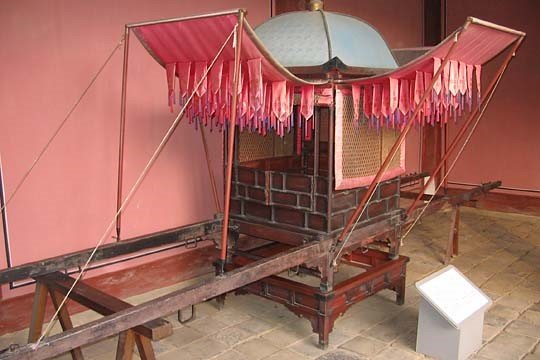
Traditional Korean funeral palanquin (sangyeo) with a decorated wooden structure, long carrying poles and red ceremonial canopy, used in Korean funeral processions.

THE PATH TO AFTERLIFE – or discovering Koreans through their furniture.

This post is the first in a series of articles related to a study of the Korean people through their arts, particularly their furniture. Most of the antique Korean furniture available today is known as “Joseon” furniture. The Joseon dynasty, also transcribed as Chosŏn or Chosun, in Korean: 대조선국, was the last dynastic kingdom of […]

Traditional Korean Jeju-do bandaji chest with reddish wooden panels, large cloud-shaped iron hinges, circular decorative fittings and geometric metal ornaments.

JEJU DO BANDAJI – 제주도 반닫이

Jeju island 제주도 in Korean , formerly Cheju, is an island off the southern coast of South Korea in the Korea Strait, southwest of Jeolla Do Province. With Gangwha in the Gyeonggi Do province, they are the only two islands were furniture with its own specific design was produced. The typical Jeju Bandaji is usually […]