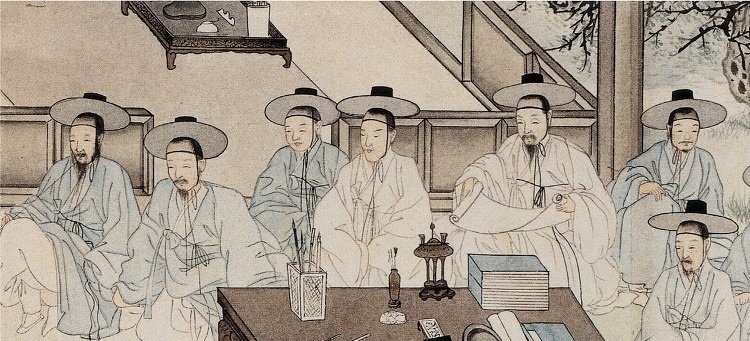
Traditional Korean painting depicting seated Joseon scholars wearing official hats and robes, gathered around a low table.

THE INFLUENCE OF NEO CONFUCIANISM ON KOREAN ART AND FURNITURE.

What is Confucianism? The primary decorative and finishing characteristics of Korean furniture as we know it today are closely linked to Neo-Confucianism, the dominant philosophy of the Joseon dynasty (1392–1897). Originating from the teachings of Confucius and later developed by Chinese scholars, Neo-Confucianism emphasized moral integrity, respect for family and social hierarchy, education, self-discipline, and […]
Traditional Korean painting showing people in Joseon-era clothing gathered outside thatched-roof houses, with a woman standing in a doorway.

A BIT OF HISTORY. THE JOSEON DYNASTY.

AN ANTHROPOLOGICAL STUDY OF THE JOSEON DYNASTY. Joseon 조선 in Korean, 朝鮮 in Hanja, or Chosŏn, officially Great Joseon State (대조선국; 大朝鮮國, was the last dynastic kingdom of Korea, lasting just over 500 years. It was founded by Yi Seong-gye in July 1392 and replaced by the Korean Empire in October 1897, but the period of Japanese rule is sometimes included in the broader understanding of the dynasty’s […]