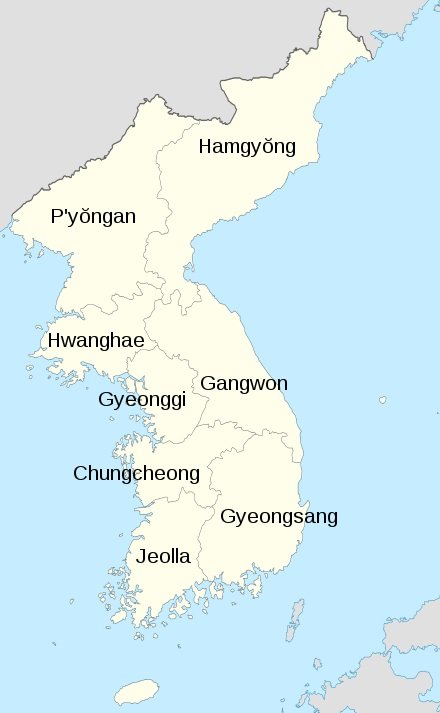
Hamgyŏng Do province was bounded on the west by P’yŏngan Do province, on the south by Hwanghae Do and Gangwŏn Do provinces, on the east by the Sea of Japan, and on the north by China and the Russian Empire.
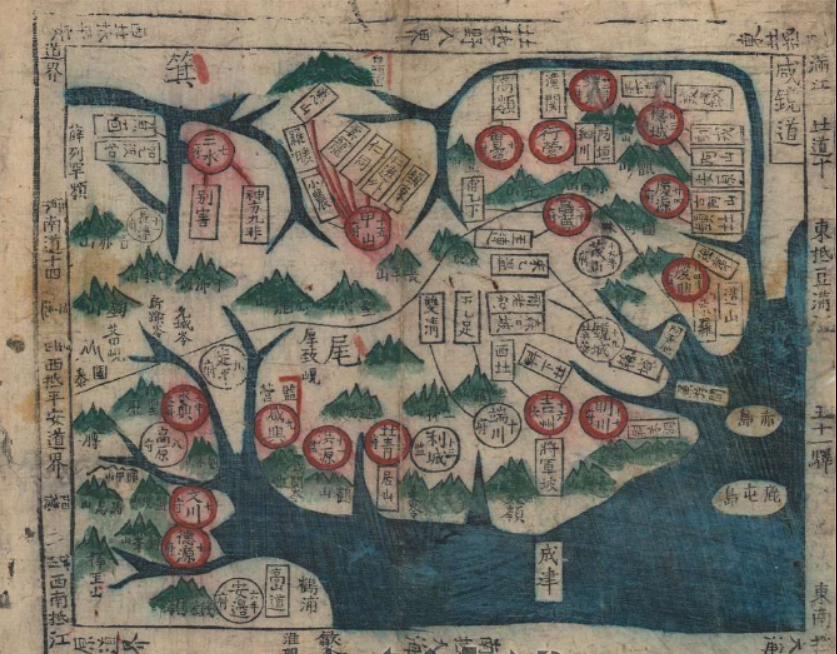
It was one of the eight provinces of Korea during the Joseon dynasty and the provincial capital was Hamhung. Hamgyŏng-Do is the peninsula’s most mineral-rich province.

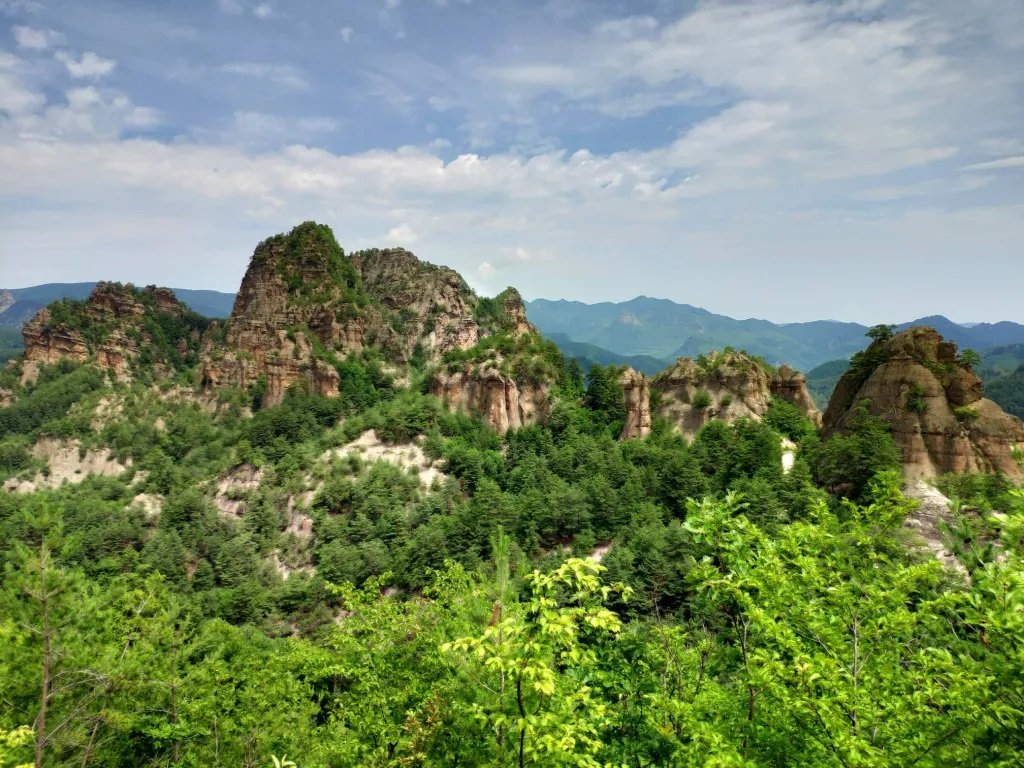
Unfortunately, despite our many attempts in our research, we lack information about the furniture in this region.
The limited documentation of antique furniture from Hamgyong province is the result of a convergence of historical and geographic factors. Located in the remote northeastern part of the peninsula, the region remained relatively isolated, attracting little scholarly or commercial attention even before the 20th century. Systematic study of Korean furniture developed late, by which time many original pieces had already disappeared. The devastation caused by the Korean War further contributed to the loss of material culture and local knowledge. Subsequently, the region’s incorporation into North Korea severely restricted access to researchers and collectors, preventing fieldwork and photographic documentation. Combined with the absence of export markets and the fragile, largely oral transmission of craft traditions, these conditions have resulted in a significant gap in both scholarship and visual records for Hamgyong furniture.
So far, we have discovered only few bandajis whose provenance is attributed to Hamgyong province.
This piece of furniture, whose size is typical of northern pieces (larger than southern pieces), seems to have been made from pine or linden woods. Its surface features numerous finely-cut wrought-iron hinges, a method used in the neighbouring province of pyongan.
The general shape of the hinges securing the front panel is rectangular. The chest stands on an high, sometimes elaborate base.
According to Kim Kyung-sook’s research, the Hamgyong bandaji displays a restrained aesthetic characterized by heavy proportions, a thick plank structure, and black cast iron fittings. Unlike bandajis from other regions, the linear form excluding artifice and the wide cast iron fittings reveal a rugged and strong regional character.
“A Study on the Regional Characteristics of Korean Bandaji”. Kim Kyung-sook, Master’s Thesis, Ewha Womans University: This study compares and analyzes the forms and metal fittings of bandaji by region, detailing the massive proportions and cast iron metal fittings of Hamgyong-do bandaji)
Further research will therefore be required to uncover the secrets hidden in this remote region.
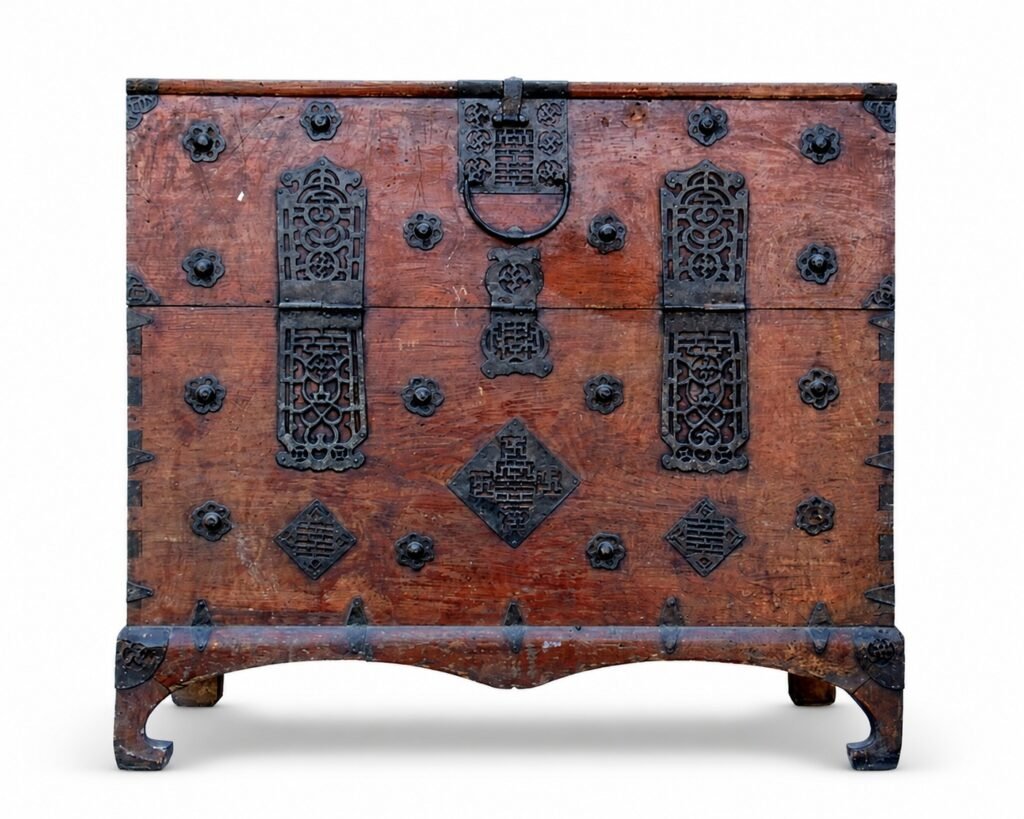
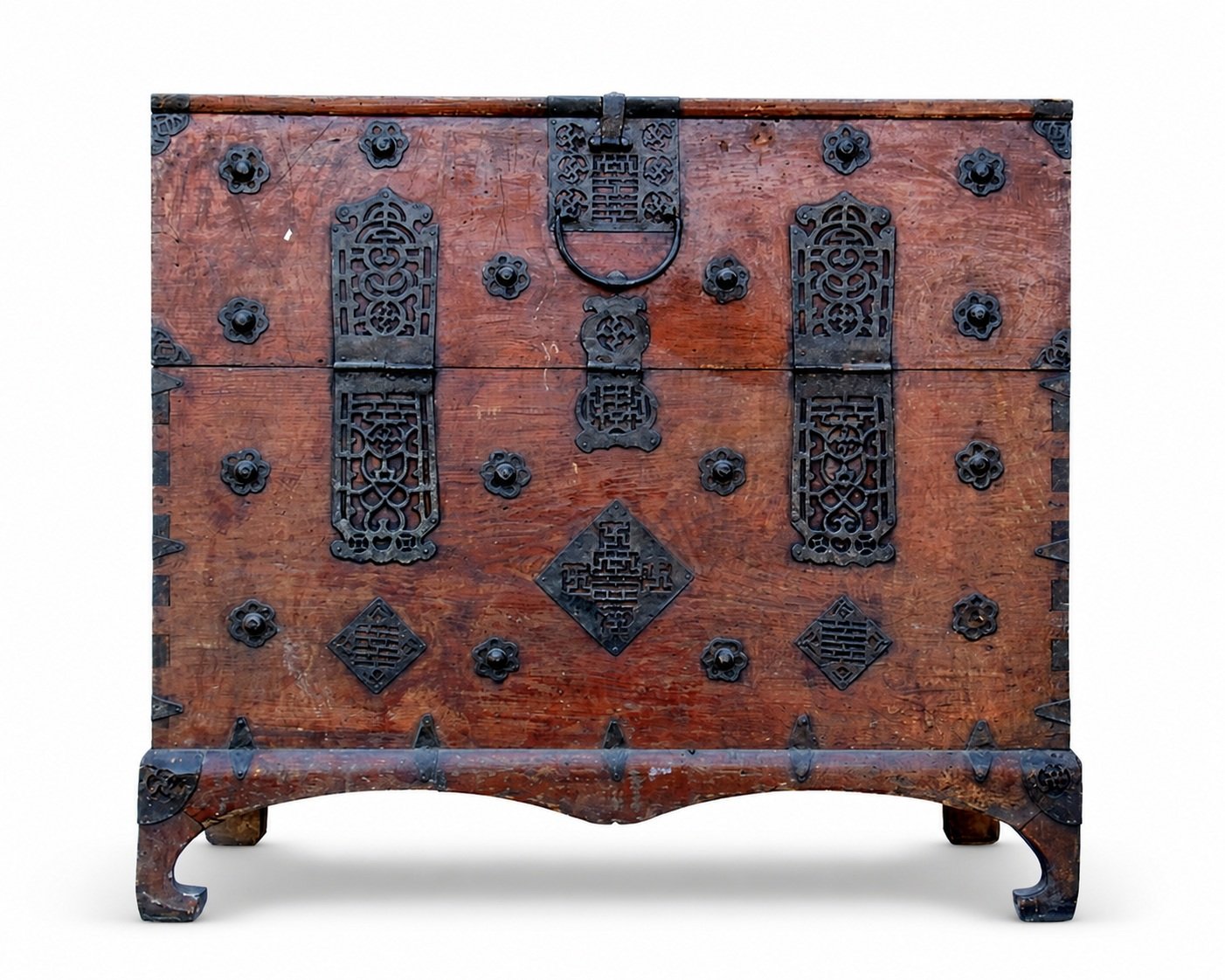
The chest is low, wide, and compact, with a slightly elevated stance on short legs. The front panel dominates visually, with a clear horizontal division between lid and body. The bottom apron shows a gentle cut-out curve, but otherwise the structure is rigid.
This emphasis on boxy volume and stability is typical of northern chests, contrasting with the more refined, proportion-driven elegance of southern pieces.
The wood appears to be a dense, medium-to-dark, likely pine or a similar northern species. The surface is plain, with minimal emphasis on grain and shows wear, patina, uneven coloration from age and use.
Visual interest was instead created through metal fittings rather than wood figure.
The chest is heavily covered with blackened iron fittings. Large vertical hinges with pierced geometric patterns, Numerous flower-shaped bosses (studs), a central lock plate and hasp, diamond-shaped appliqués with stylized motifs and reinforced corners and edges.
The fittings designs are geometric and symbolic, rather than delicate or ornamental and the iron has a forged, slightly rugged character.
This is not an elite display piece. It suggests a storage for clothing or household goods.
this chest fits closely with traditions linked to Hamgyŏng-do and by extension, the Korean diaspora culture in Yanbian, where many migrants originated from the northern part of Korea.
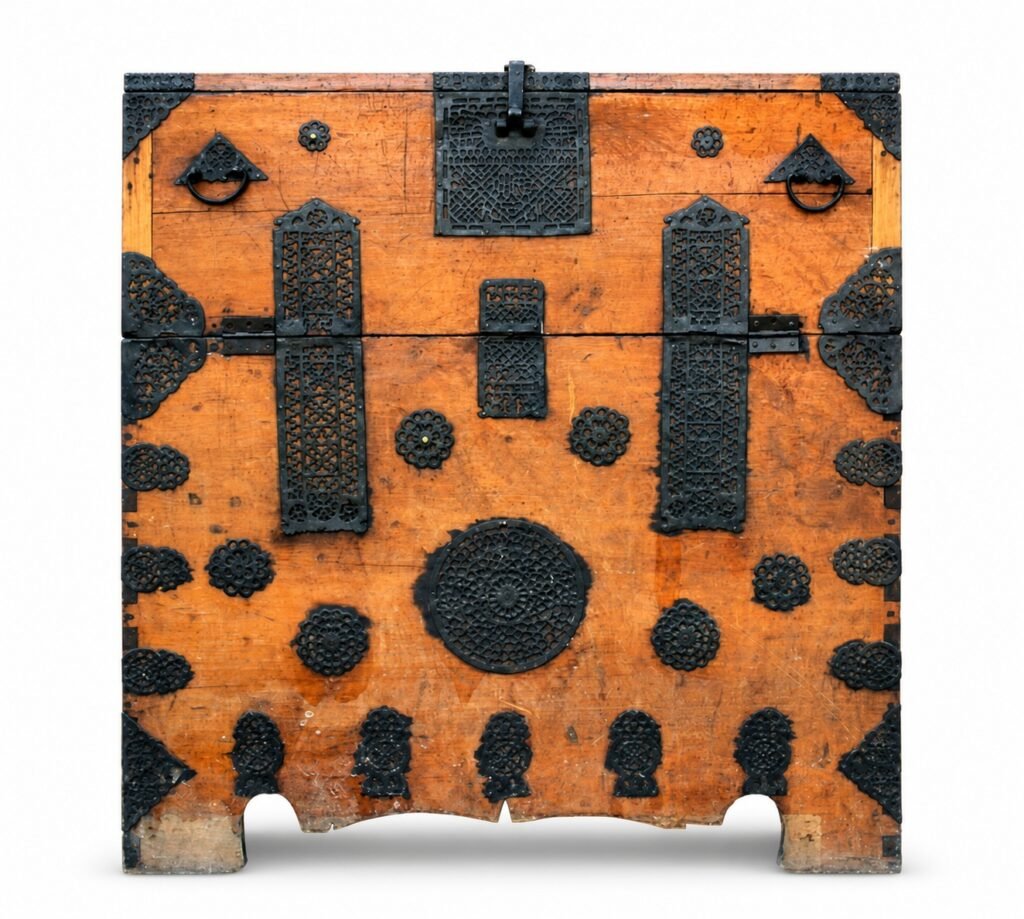
This bandaji is most plausibly attributed to Hamgyong province and is characterized by its distinctive and highly expressive metalwork.
The chest retains the robust, architectural presence typical of northern furniture, yet departs from strict austerity through its richly ornamented façade. The surface is animated by an abundance of pierced iron fittings, including elongated strap hinges (2), corner mounts, and numerous small appliqués arranged in a dense, rhythmic pattern. A large circular medallion at the center anchors the composition, creating a strong visual focal point.
The wood, warm in tone and relatively plain in grain, serves as a contrasting backdrop to the dark, intricately worked iron. Its finish is unusual, a dark stain was often applied to over the wood to mask its poor grain.
Despite the decorative emphasis, the placement of the fittings remains structurally grounded, reflecting the northern tradition where metalwork plays both a functional and aesthetic role.
The subtly pronounced cut-out base apron is characteristic of this region, where chests were elevated to protect them from the heated floors.
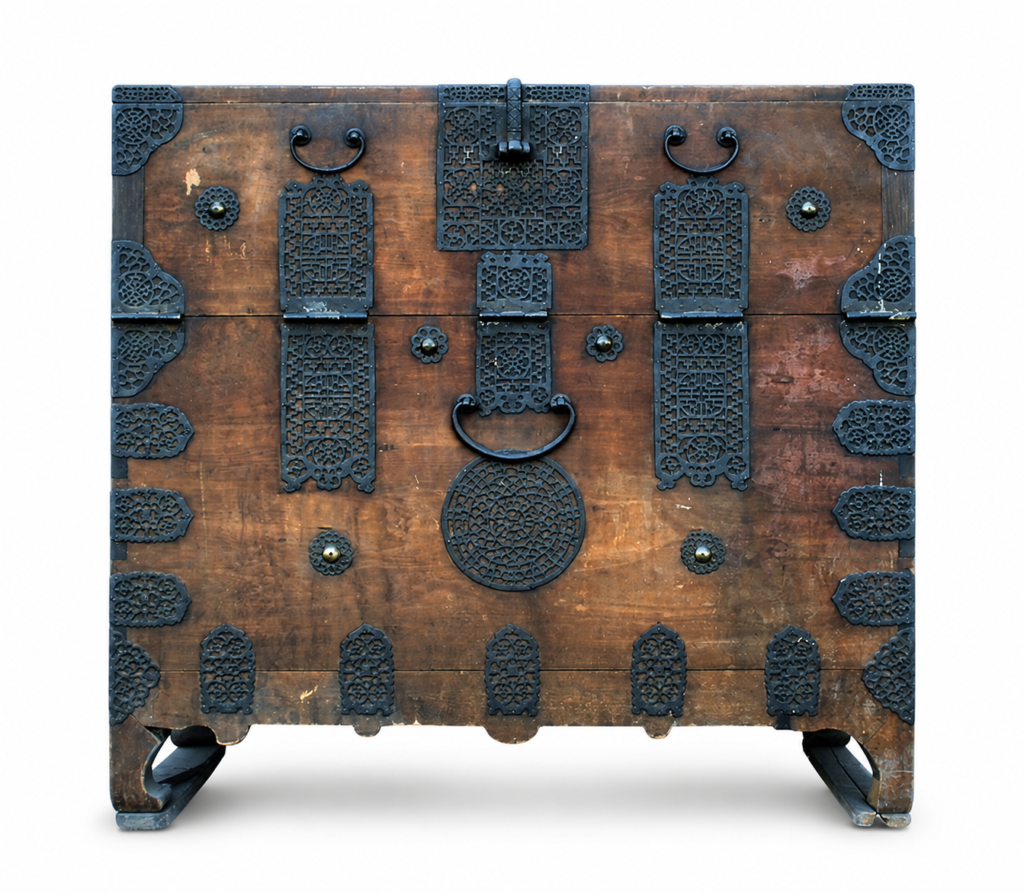
The chest is defined by its broad, architectural form, elevated on distinctive bracket-like feet that lift the body above the floor, an adaptation associated with regions using underfloor heating. The wood surface, warm and softly patinated, shows relatively subdued grain, allowing the metalwork to dominate visually.
The façade is richly adorned with intricate pierced iron fittings, arranged in a dense yet balanced composition. Elongated vertical straps, corner mounts, and numerous small appliqués create a rhythmic surface, while a large circular medallion with a suspended ring pull forms a strong central focal point. The ironwork, though highly decorative, remains structurally integrated, reflecting the northern tradition in which hardware serves both functional and aesthetic purposes.
Overall, the piece exemplifies a decorative Hamgyong variant, where the robust construction typical of northern bandaji is combined with an unusually elaborate and expressive use of metal ornament.
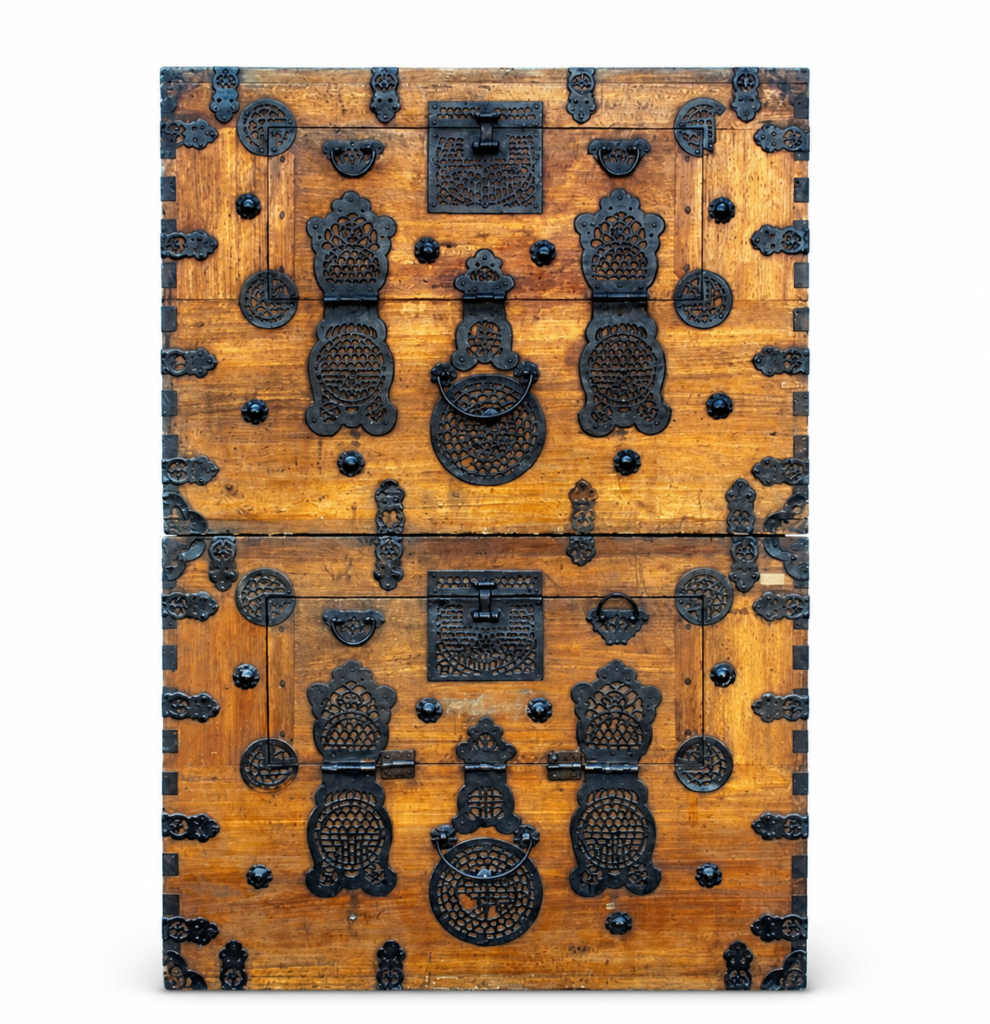
In an article published on this same website: KOREAN FURNITURE WITH MODIFIED DESIGNS. we presented pieces of furniture with atypical designs that clearly stand apart from the classical forms of Korean furniture. Among them were a number of multi-tiered bandaji. We noted, with some surprise, that most of these originated from Gangwon province, an isolated region in the southeast of the peninsula that shares a border with Hamgyong province. It is interesting to observe that this same type of bandaji is also found in Hamgyong province. A few examples are presented below.
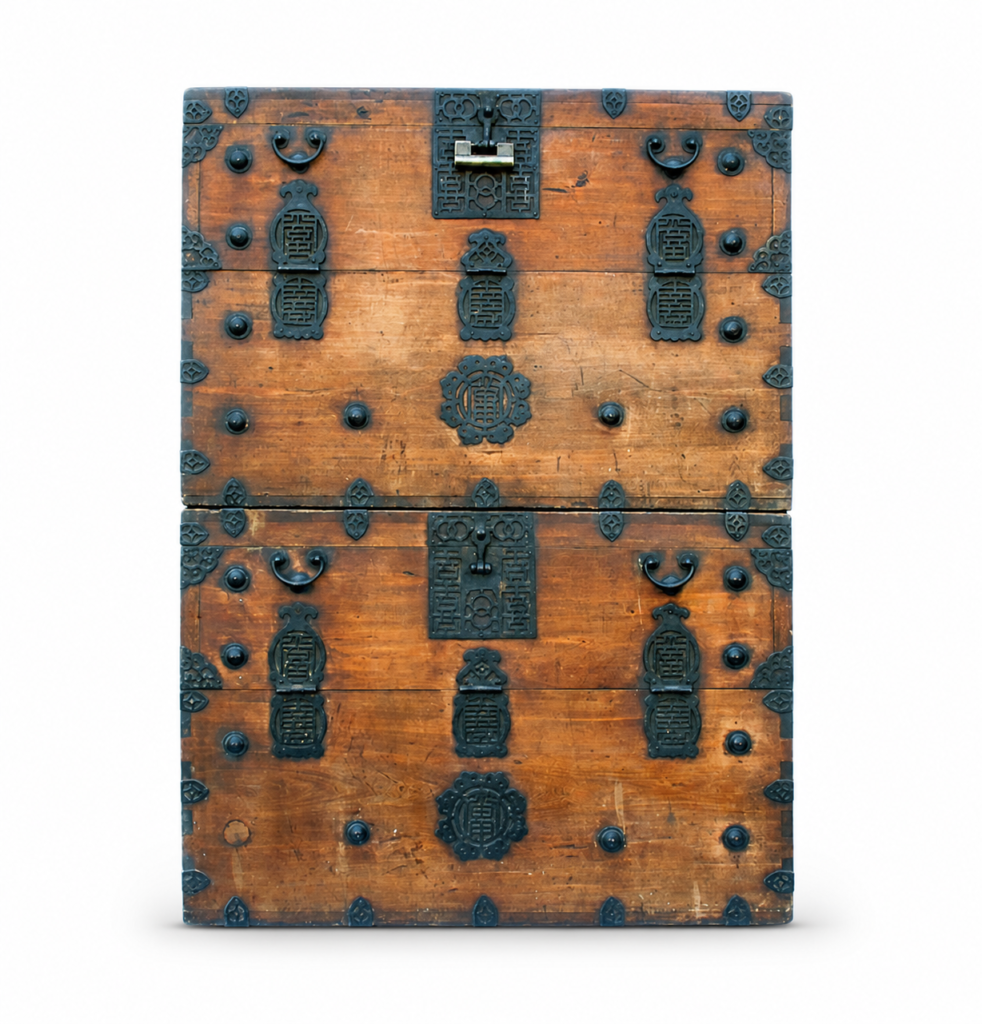
PHOTO ABOVE: This Korean two-tiered Bandaji, is likely dating from the late Joseon period or the early 20th century. Constructed from warm-toned softwood, it consists of two separate storage compartments placed one above the other, a form used in the northern regions of the Korean peninsula where large-capacity storage was essential. The chest is richly adorned with blackened iron fittings, including corner brackets, decorative lock plates, ring handles, and pierced escutcheons featuring stylized longevity (壽) motifs. The contrast between the honey-brown wood and the dark metalwork creates a bold and elegant appearance. Extensive wear, scratches, and a mellow patina testify to decades of use, while the robust construction and restrained ornamentation reflect the practical yet refined aesthetic characteristic of traditional Korean furniture.
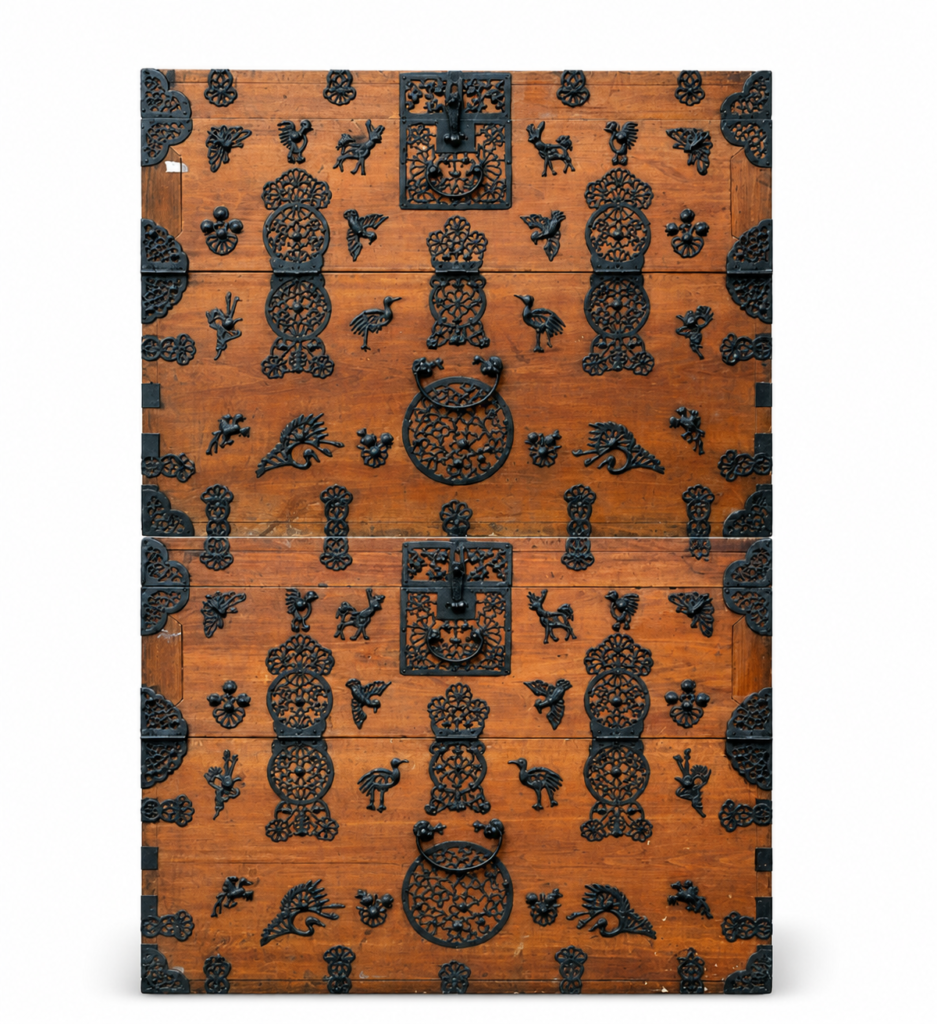
PHOTO ABOVE: This impressive two-tiered Bandaji is composed of two matching compartments. It is crafted from richly grained honey-brown wood and lavishly adorned with openwork iron fittings. Unlike more restrained examples, nearly every surface is decorated with pierced and appliqué metal ornaments depicting auspicious motifs, including deer, cranes, phoenix-like birds, flowering plants, and butterflies. These symbols were traditionally associated with longevity, prosperity, happiness, and harmony.
The large pierced lock plates, circular ring handles, and ornate vertical straps create a striking contrast against the warm wood, transforming the chest into a decorative showpiece as much as a storage cabinet. Such exuberant metalwork is characteristic of northern Korean furniture traditions, particularly pieces produced in the Hamgyŏng and P’yŏngan regions during the late Joseon period and early twentieth century. The abundance of symbolic decoration, combined with the chest’s substantial size and visual impact, suggests that it was intended for a prosperous household and occupied a prominent place within the women’s quarters.
The chest displays a beautifully aged patina, with the softened wood surface and darkened ironwork reflecting generations of use while preserving the vibrant decorative character that distinguishes northern Korean furniture from the more austere styles of the central and southern provinces.