
The post-Joseon era in Korea began in 1897 and encompasses the period following the Joseon dynasty (1392–1897), including the Korean Empire, Japanese colonial rule, and the division into North and South Korea. It is marked by a period of rapid modernization, intense external pressures, and national upheaval.
KEY PERIODS FOLLOWING THE JOSEON DYNASTY.
The establishment of the Korean Empire occurred in 1897 when Gojong became an emperor, which officially marked the fall of the Joseon Kingdom and Korea’s independence from China’s traditional influence.
This brief era was known for political reforms and increasing foreign influence. Emperor Gojong tried to improve Korea through the introduction of Western technologies and infrastructure, as well as education and governmental systems. The annexation of Korea by Japan happened in 1910, which put an end to the Korean Empire.
JAPANESE COLONIAL RULE (1910–1945)
After forcing the annexation of Korea in 1910, the Empire of Japan enacted a harsh 35-year rule that was met with Korean resistance.
Japan systematically destroyed or damaged traditional Korean architecture, including much of the Gyeongbokgung palace complex. It also repressed traditional art forms and promoted Japanese artistic styles.
POST-WORLD WAR II & NATIONAL DIVISION (1945–present)
Japanese rule ended in 1945 with the conclusion of World War II, but the era of freedom was short-lived as Korea was divided.
IMPACTS ON KOREAN FURNITURE.
Before the 20th century, Korean furniture, especially from the Joseon Dynasty, was defined by its simple elegance, functionality, and focus on the natural grain of wood. This was closely tied to a floor-based, Neo-Confucian lifestyle, with different quarters of the house furnished according to gender and purpose.
As the Joseon Dynasty gave way to the Korean Empire and then Japanese rule, Korean society became more open to foreign influences, which in turn reshaped furniture design.
Despite many foreign influences that were present at that time, traditional Korean Joseon-era furniture style remained. At the same time, some items began to have additional decorations and designs under the influence of Chinese, Japanese, and Western styles.
The changes that have taken place in the field of Korean furniture in that period can be compared to a certain extent to the changes that have occurred in the sphere of European furniture in the second part of the nineteenth century. In both cases, one can trace the tendency to move from rather conservative traditional designs to larger furniture with more complex ornamentation and an increased number of stylistic influences. However, the reasons for these tendencies are not quite the same. In the case of Korea, these changes were caused by the destruction of the traditional social order of Joseon.
The pair of cabinets shown in the photo hereunder illustrates the modifications of dimensions and finishes we witness during the post-Joseon period.
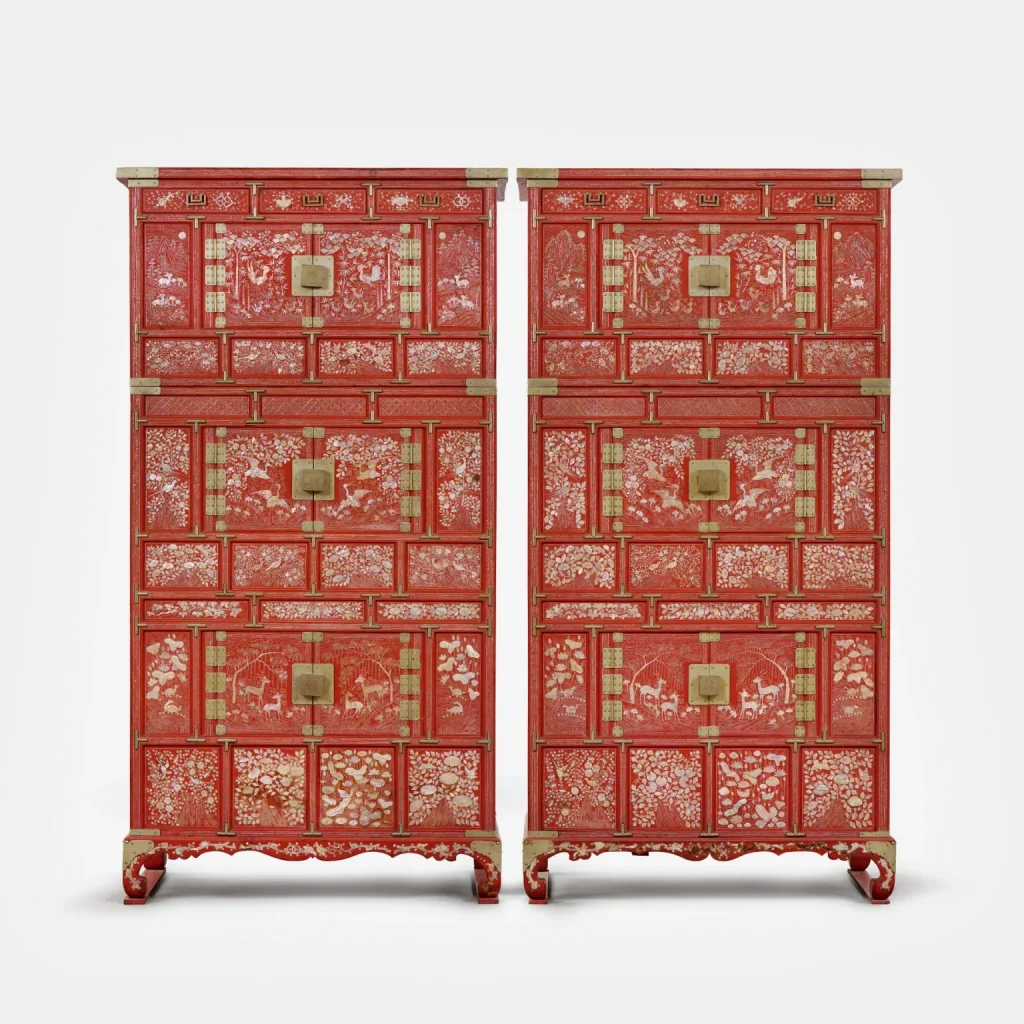
Joseon Dynasty. Early 20th century. Collection: Ewha Women’s University Seoul.
FURNITURE DIMENSION.
For most of the Joseon Dynasty, Koreans valued simplicity, restraint, and functionality in their furniture. However, during the latter part of the nineteenth century, while such values were still upheld, there had been marked changes in the environment around it. There was a gradual weakening of the power held by the yangban elite, the rise of wealthy merchant families, as well as changing socio-economic situations of certain social classes. Hence, furniture served both as a functional object and as a symbol of prosperity.
Korean furniture in the past was designed in accordance with the standards of Korean architecture and interiors, especially the small rooms and floor-based lifestyle of Korean houses. In the late Joseon and Korean Empire periods, some cabinets and chests became taller and wider.
A number of reasons could have led to this situation:
- The increased amount of clothes, fabrics, and household items owned by rich people.
- The growing need for furniture which symbolizes richness and high social standing.
- The increased influence of furniture styles borrowed from China, Japan, and the West.
- The development of urban markets and commercial furniture production.
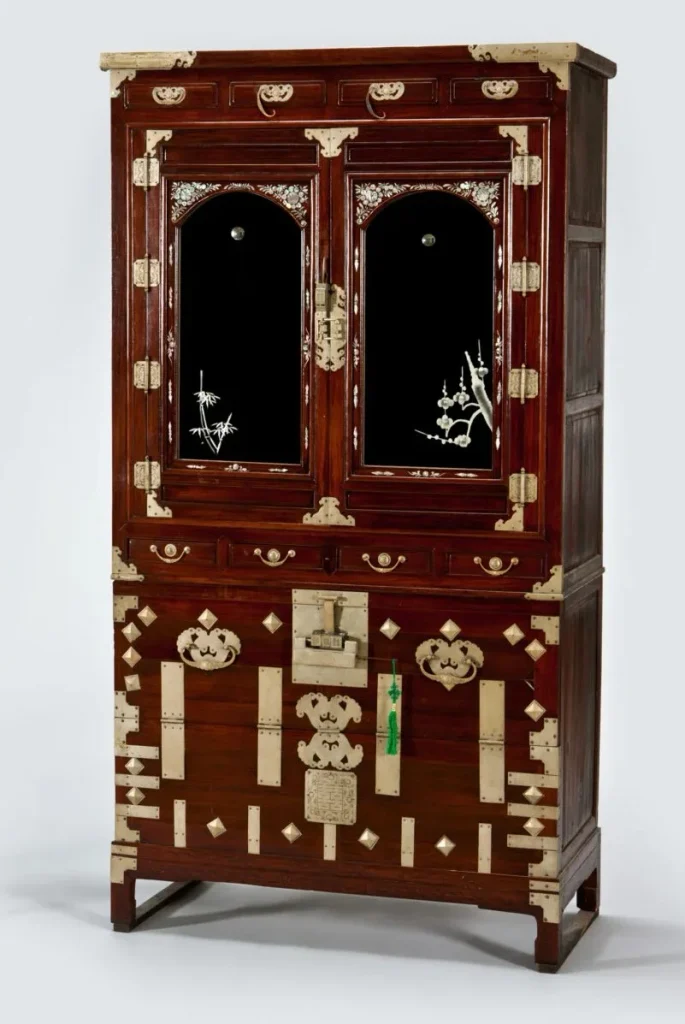
The photos hereunder illustrates perfectly the furniture dimension modifications.
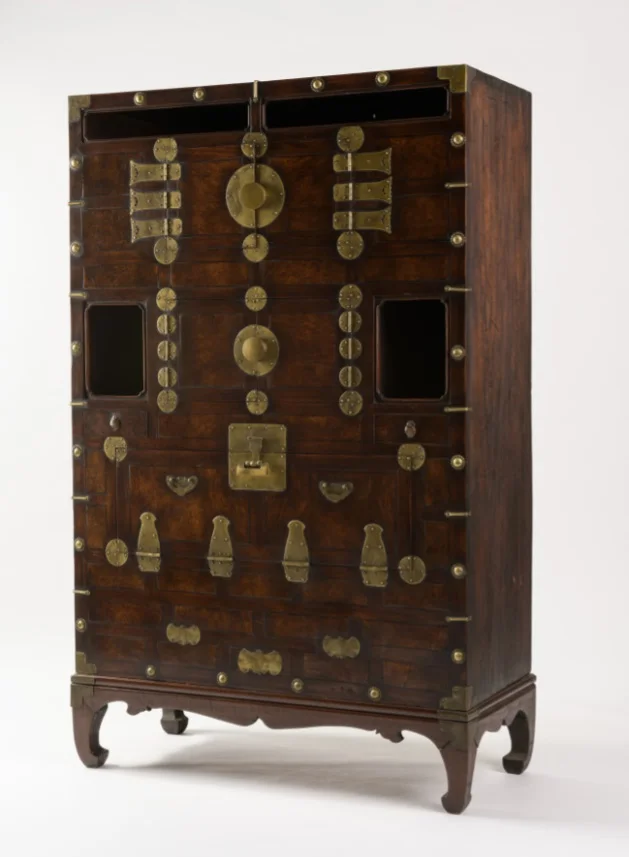
H. 149,6cm, W. 98,5cm, D. 44cm.
Collection: Seoul Museum of Craft Arts.
This large cabinet combine a “bandaji” (lower part) and a document chest (upper part). A new hybrid form rarely seen before.
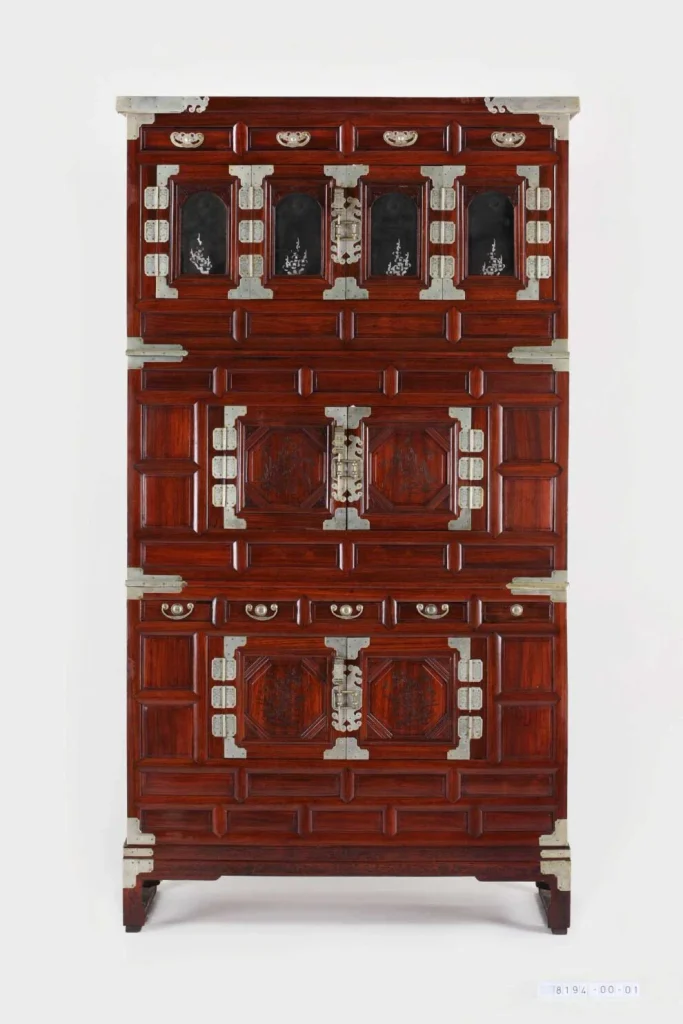
The height of this piece of furniture has increased, and we note a new design for the upper-section doors, incorporating glass panels.
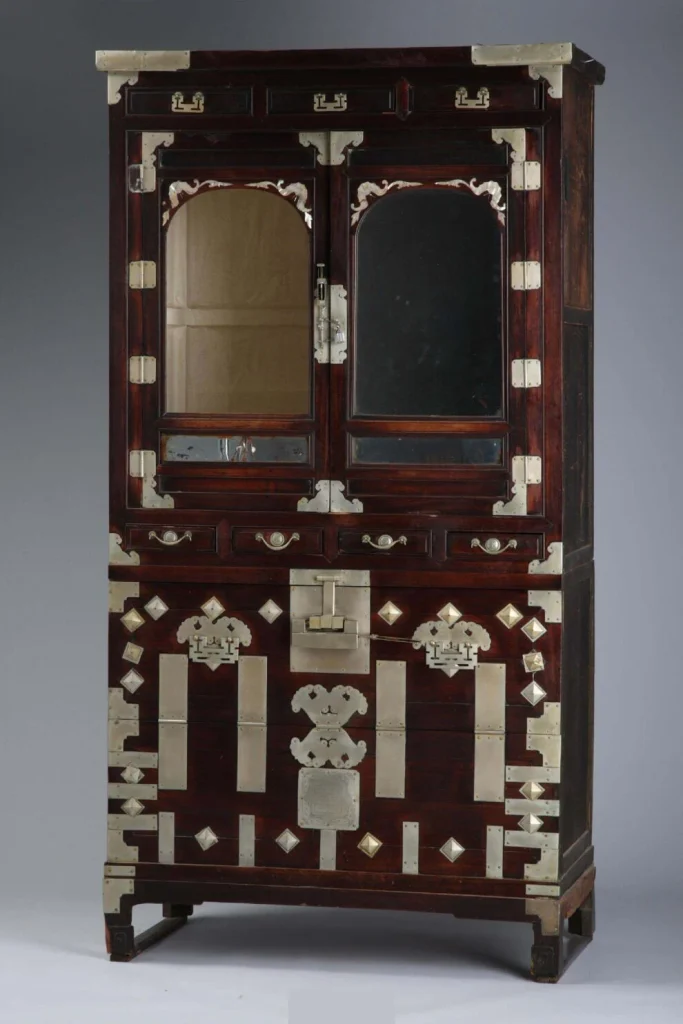
Emergence of new styles: The early 20th century saw unique designs, such as the “Uigori Jang”, a wardrobe-like cabinet that often featured yellow or white brass hardware. (Photos below).
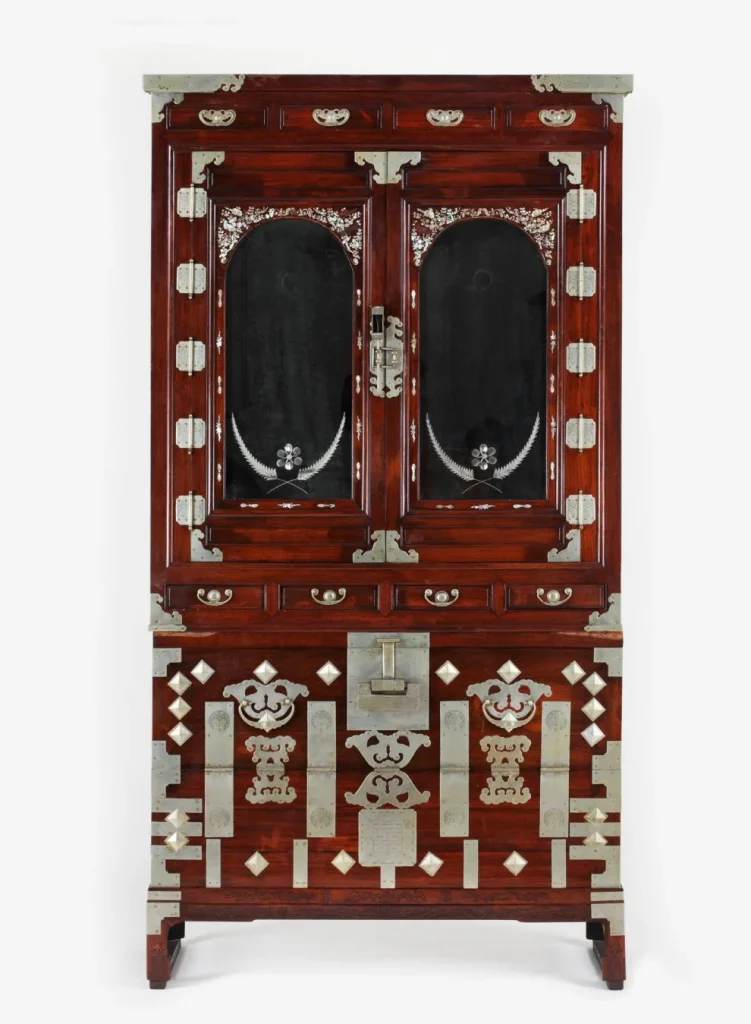
Collection: Gyeonggi provincial Museum.
H. 190,7cm, W. 99cm, D. 46,3cm.
Collection: National Museum of Korea.
Collection: National Folk Museum of Korea. Seoul.
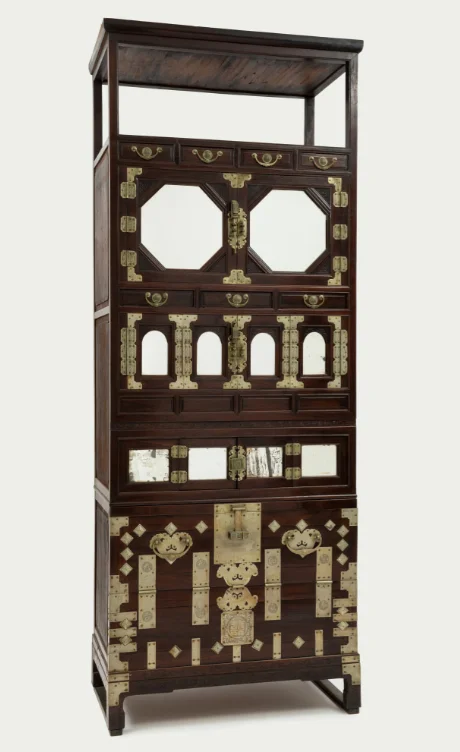
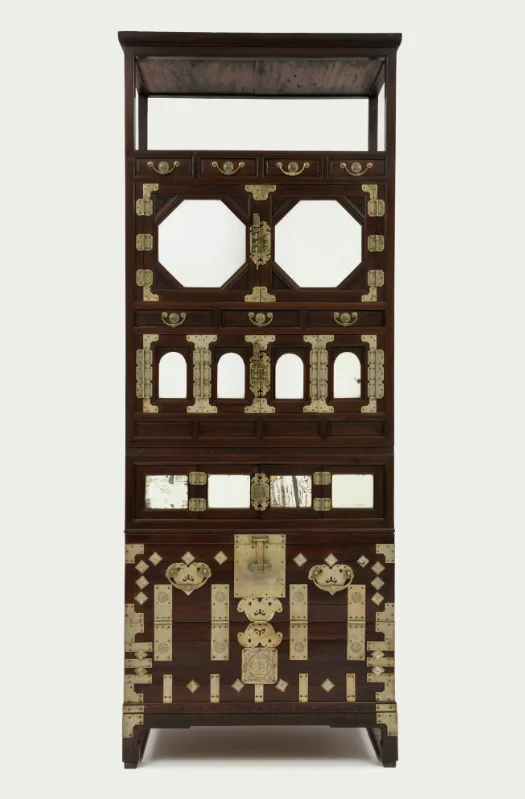
PHOTO ABOVE: This is a five-tiered cabinet consisting of a bandaji type chest with a hinged front flap on the first tier, with additional cabinets stacked above it. The third and fourth tiers contain mirrors. The nickel and the fittings decorations are splendidly executed.
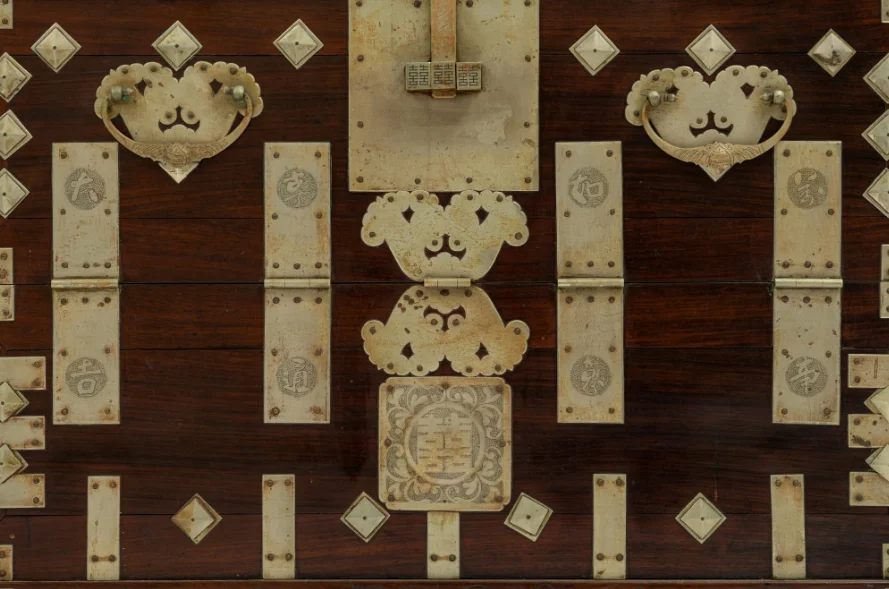
At the bottom of the first tier, the following inscription is carved:
京城寺洞衣欌元祖興号特製商文鳳鎬 (Gyeongseong sadong uijang wonjo wonyeoheo teukje sang Mun Bong-ho).
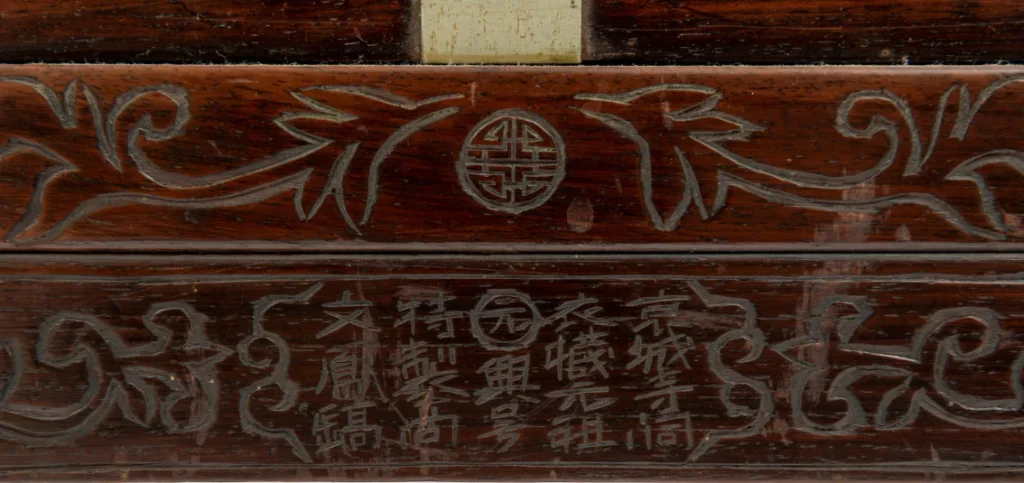
This indicates that the cabinet was made in Sa-dong (寺洞, today’s Insa-dong), Gyeongseong (present-day Seoul). The designer, Mun Bong-ho, was a highly regarded cabinetmaker, recognized as the originator of the modern wardrobe form. He originally served as a royal cabinetmaker during the Korean Empire period.
This five-tiered cabinet by Mun Bong-ho was considered one of the finest articles for marriage at that time.
FINISHING METHODS
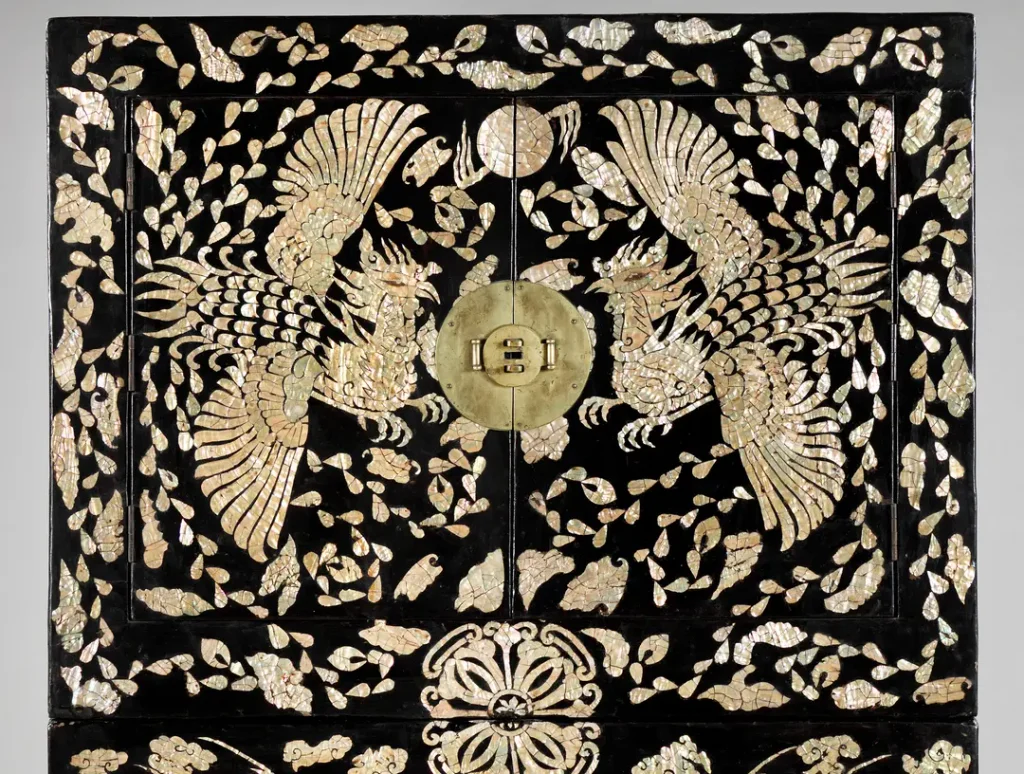
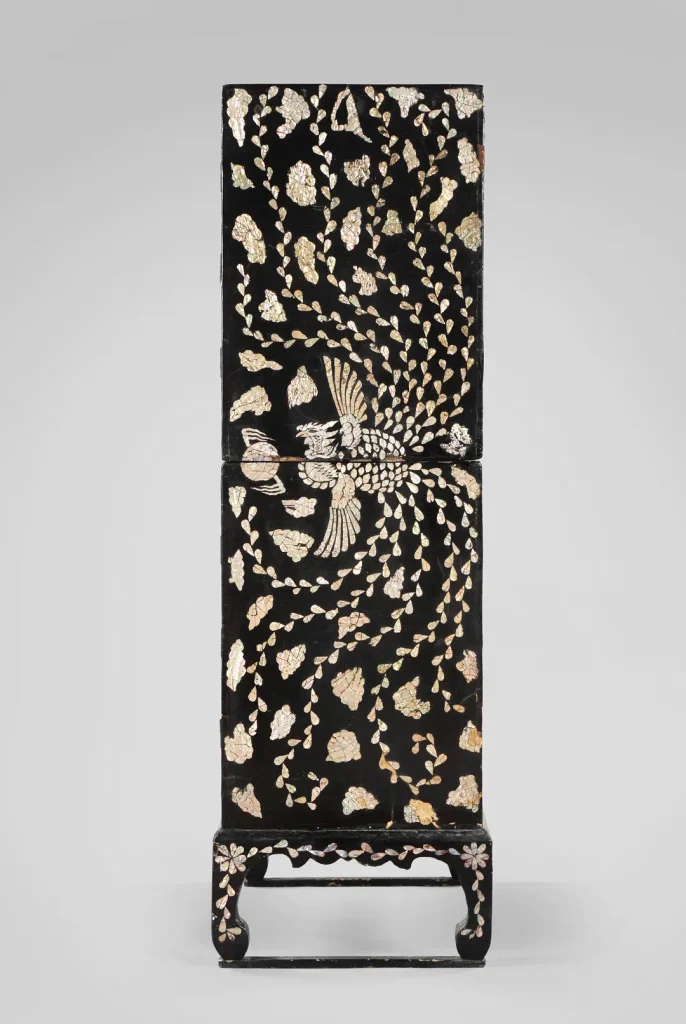
One of the most noticeable trends was the increased use of brass hardware, metal decorations, mother-of-pearl inlays, and increasingly complex decorative designs. In some of the later pieces, the decoration became so prevalent that it dominated the wooden structure.
This was quite different from the more subtle style of many of the cabinets of earlier scholars, where the beauty of the wood grain, proportion, and structure were emphasized. It is necessary to avoid assuming that all of the more complex Korean furniture was later in date; there were very decorative furniture pieces, used in the women’s quarters, that predated the Korean Empire.
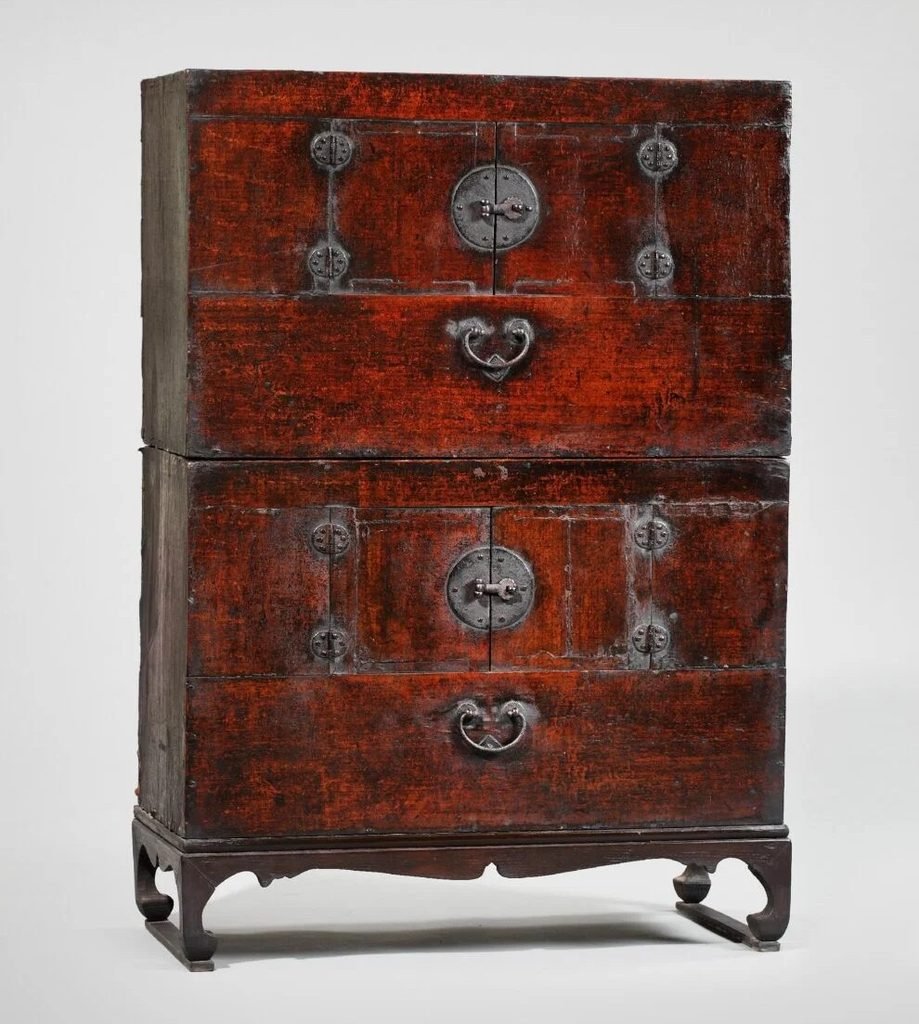
Mid to late 19th century.
Collection: Andong City Folk Museum, Gyeongsang Province
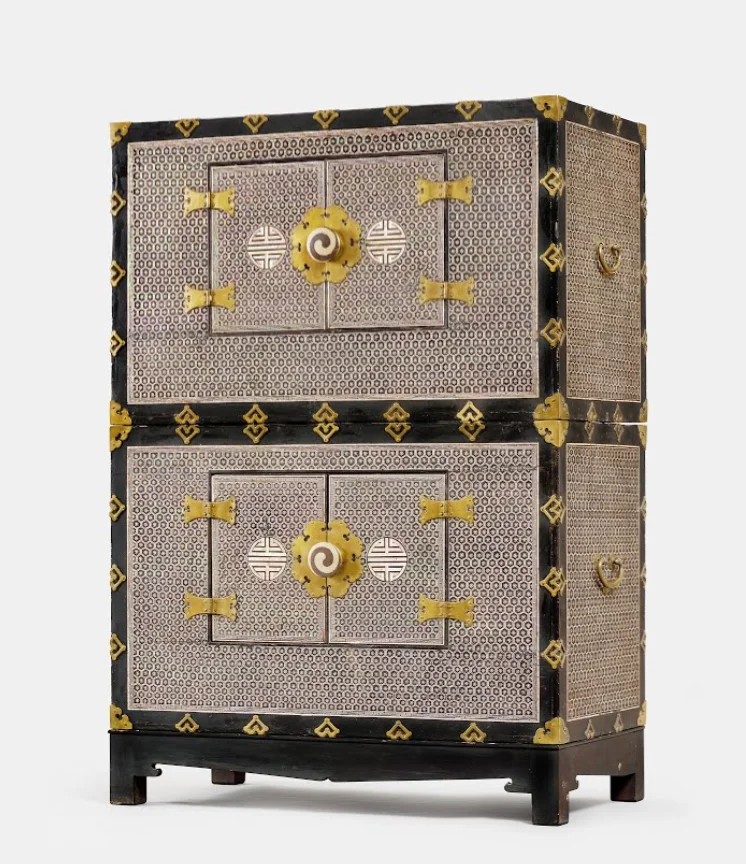
Early 20th century. H. 114,7cm.
Collection: Ewha Women’s University, Seoul
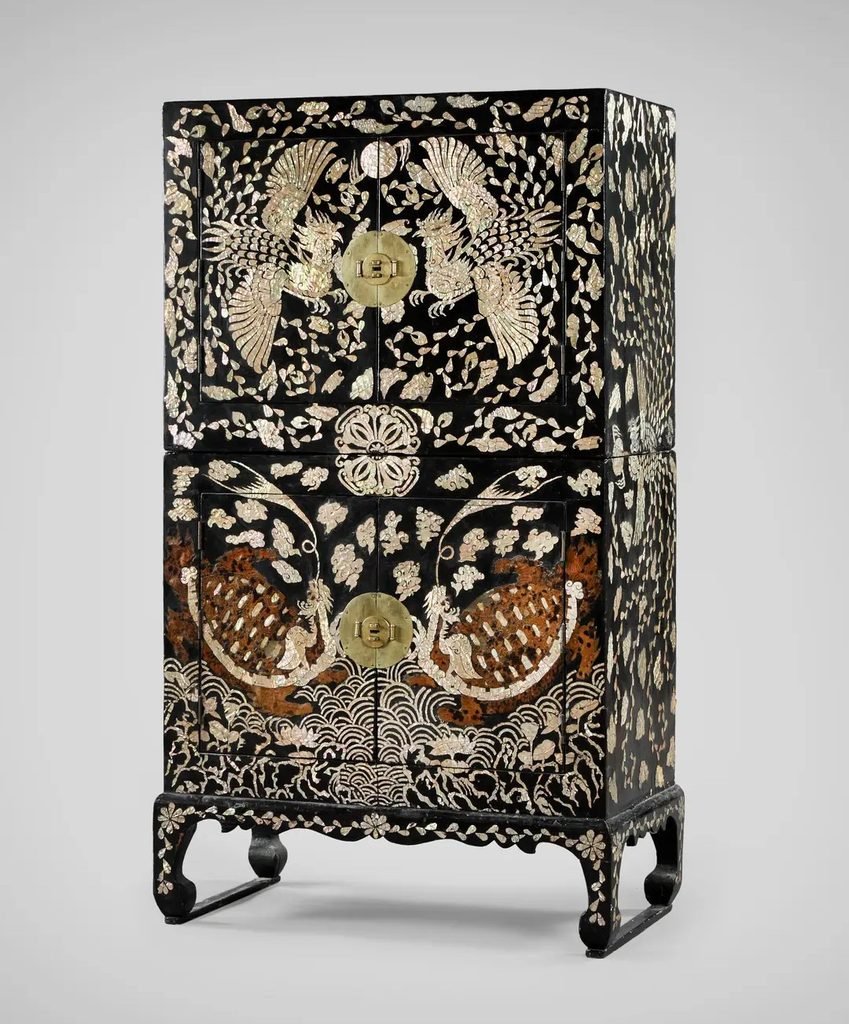
Korean Empire (1897 – 1910).
H. 156cm, W. 79cm, D. 42cm. Collection: Kyungwoon Museum, Seoul.
This “nong” appears to be a post-Joseon piece, possibly dating from the early 20th century.
In contrast to the sobriety and simplicity of earlier Korean furniture, this chest features elaborate and abundant decoration, reflecting changing tastes during the later period.
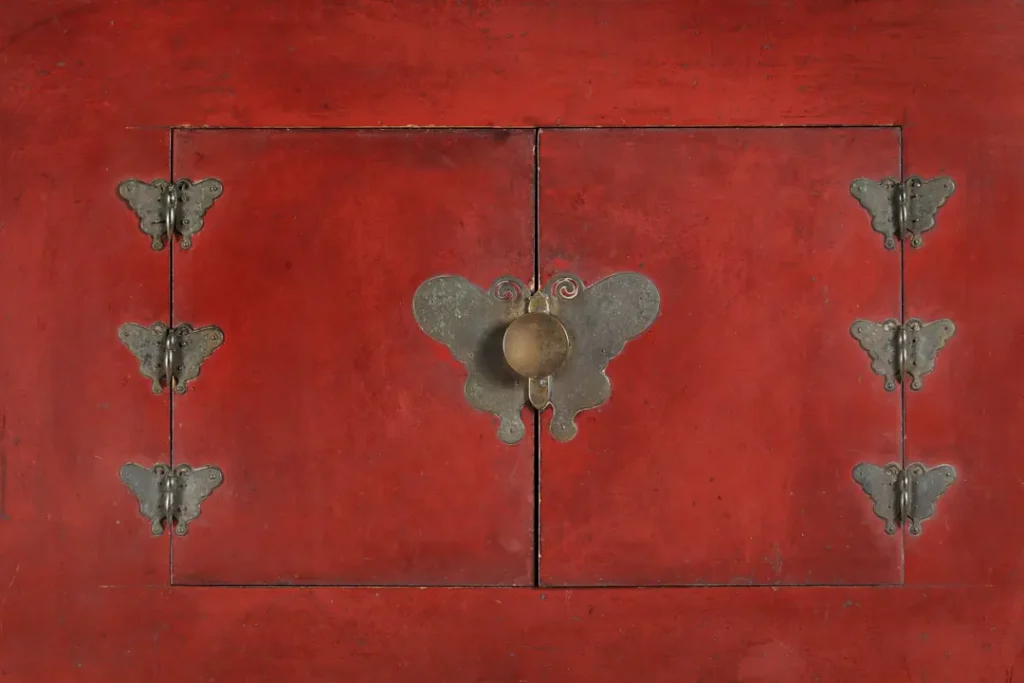
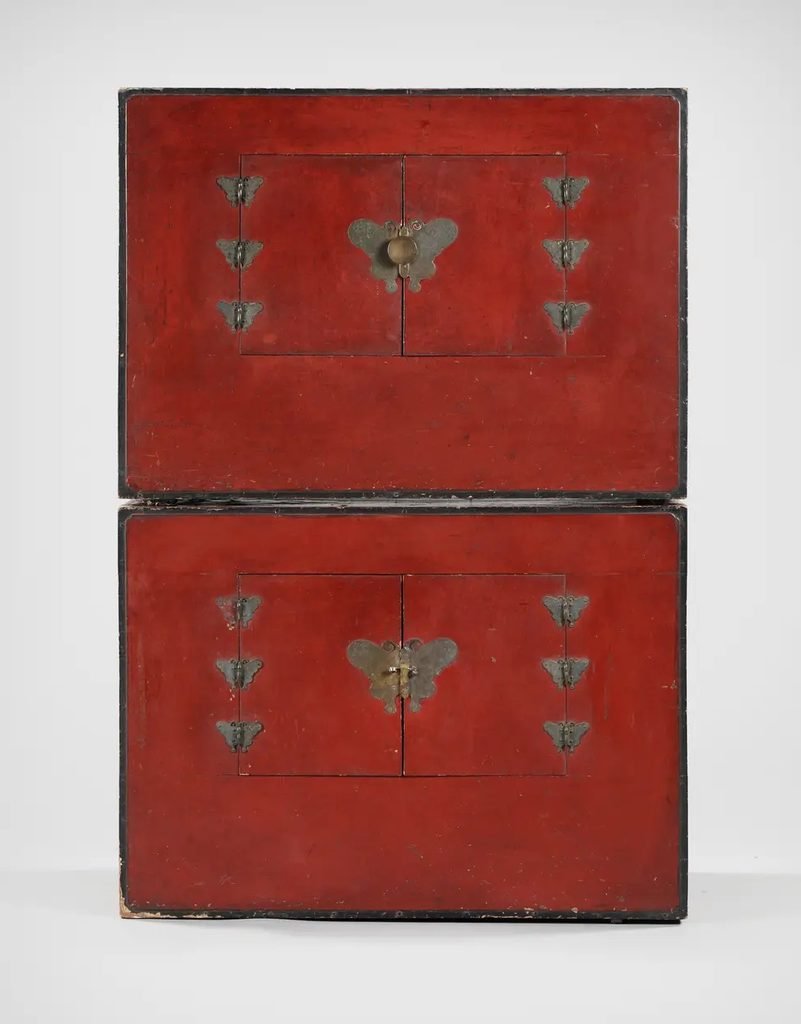
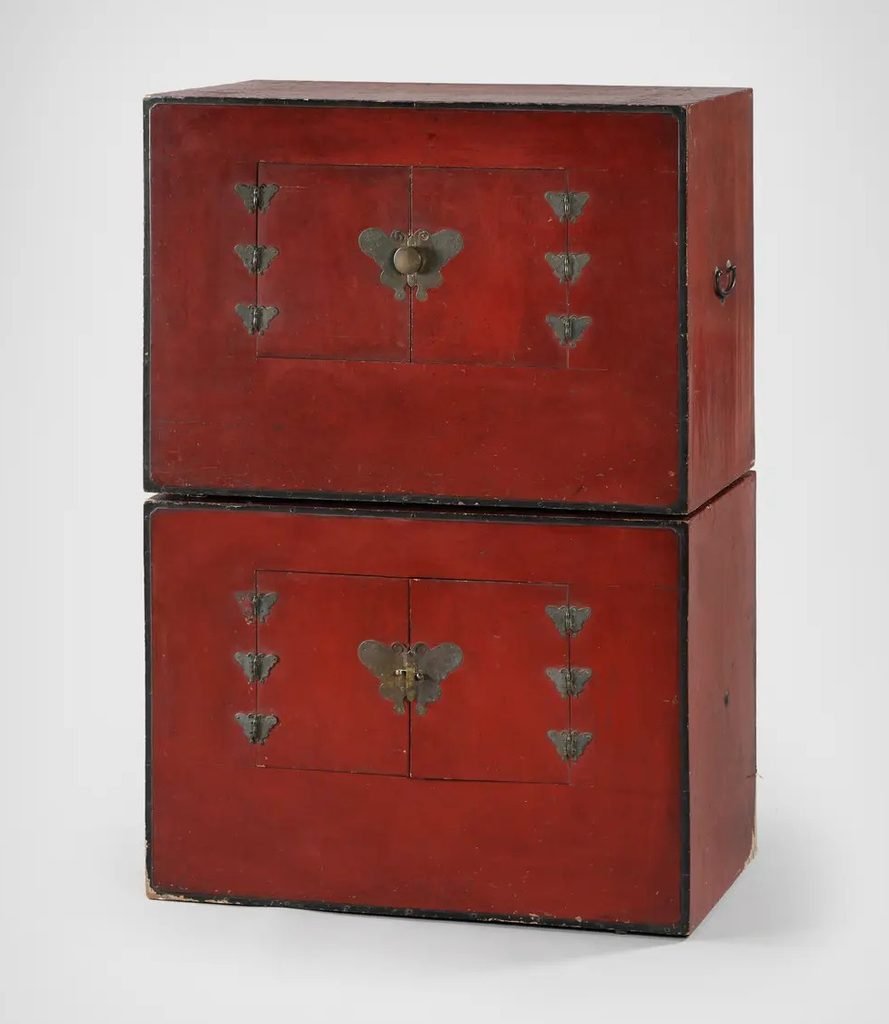
Historical context of Red Lacquer: During most of the Joseon Dynasty (1392–1910), strict laws legally restricted the use of red lacquer solely to the royal household. However, a few rare pieces did exist, notably certain bandaji chests from Hwanghae Province. On this subject we invite you to consult our publication on Hwanghae Bandaji.
By the 1890s, these laws were lifted, creating an explosion of lavishly decorated red-lacquer dowry furniture commissioned by wealthy non-royal elites, as evidenced by this “nong” (photo hereunder) dating from the Korean Empire.
FURNITURE NEW DESIGNS.
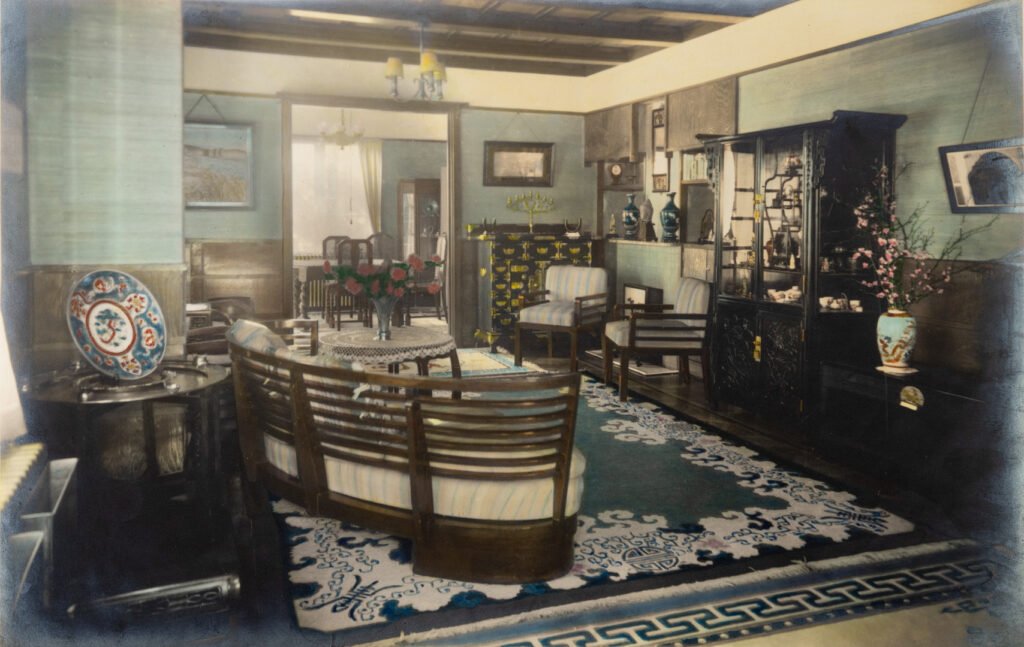
Western influence: Missionaries and Westerners who came to Korea in the late 19th and early 20th centuries were among the first foreign collectors of traditional Korean furniture, but they also brought Western tastes and a demand for different items. This led to modifications of traditional Korean designs to serve Western functions.
Main modifications were made to traditional Korean furniture, particularly chests, to cater to the tastes and functional needs of Westerners during the colonial era. These hybrid pieces often featured more decorative metalwork, were sometimes repurposed for different uses, and were built to larger sizes than traditional Korean furniture designed for floor-based living.
Metalwork advancements: New, elaborate techniques were employed for metalwork, including engraving, embossing, and incising. White and yellow brass became more common, particularly on chests, cabinets, and boxes.
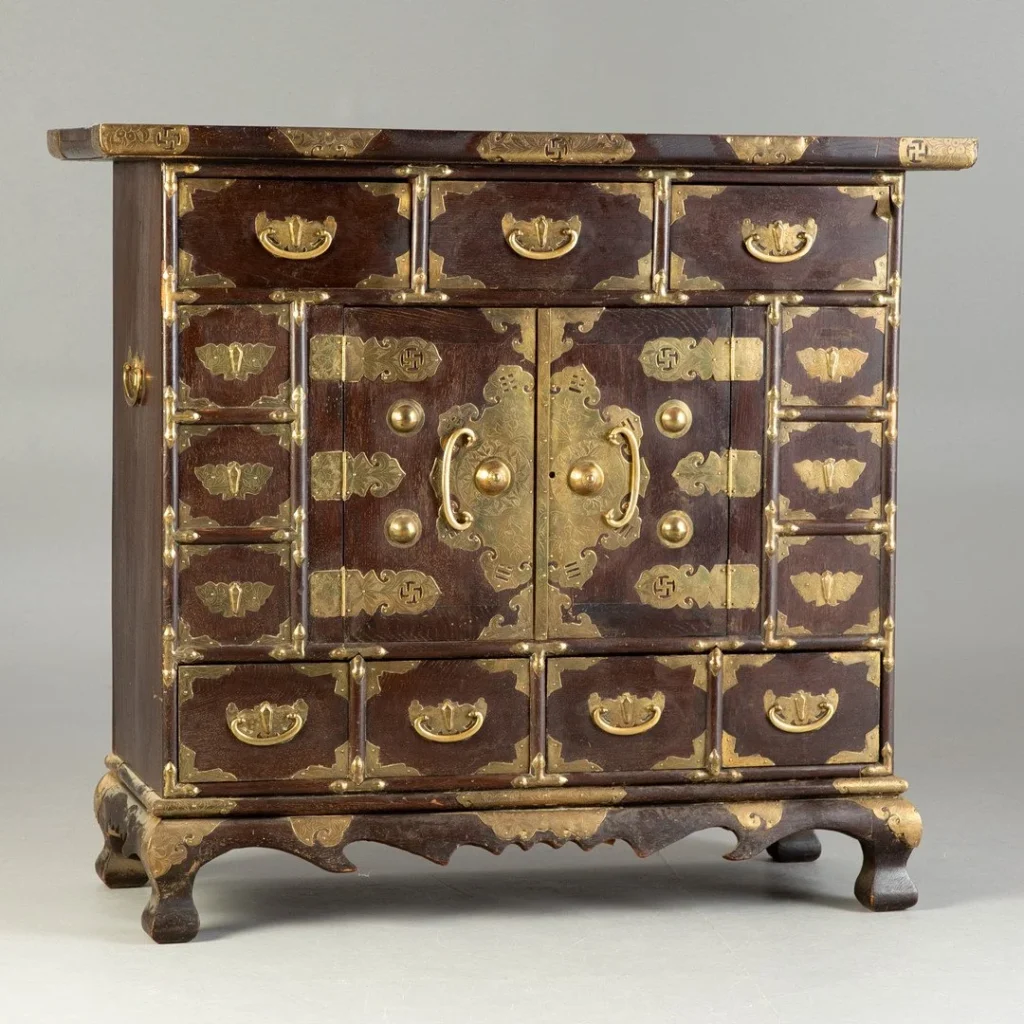
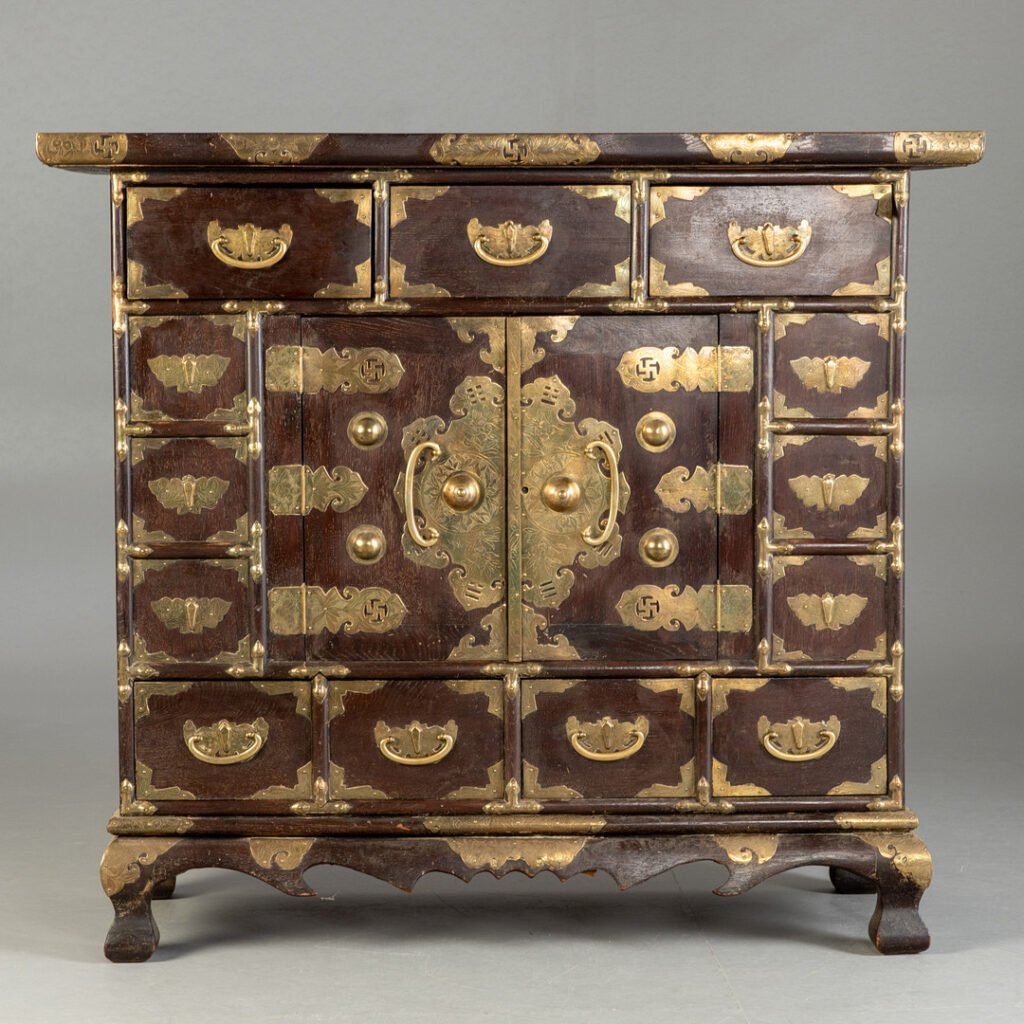
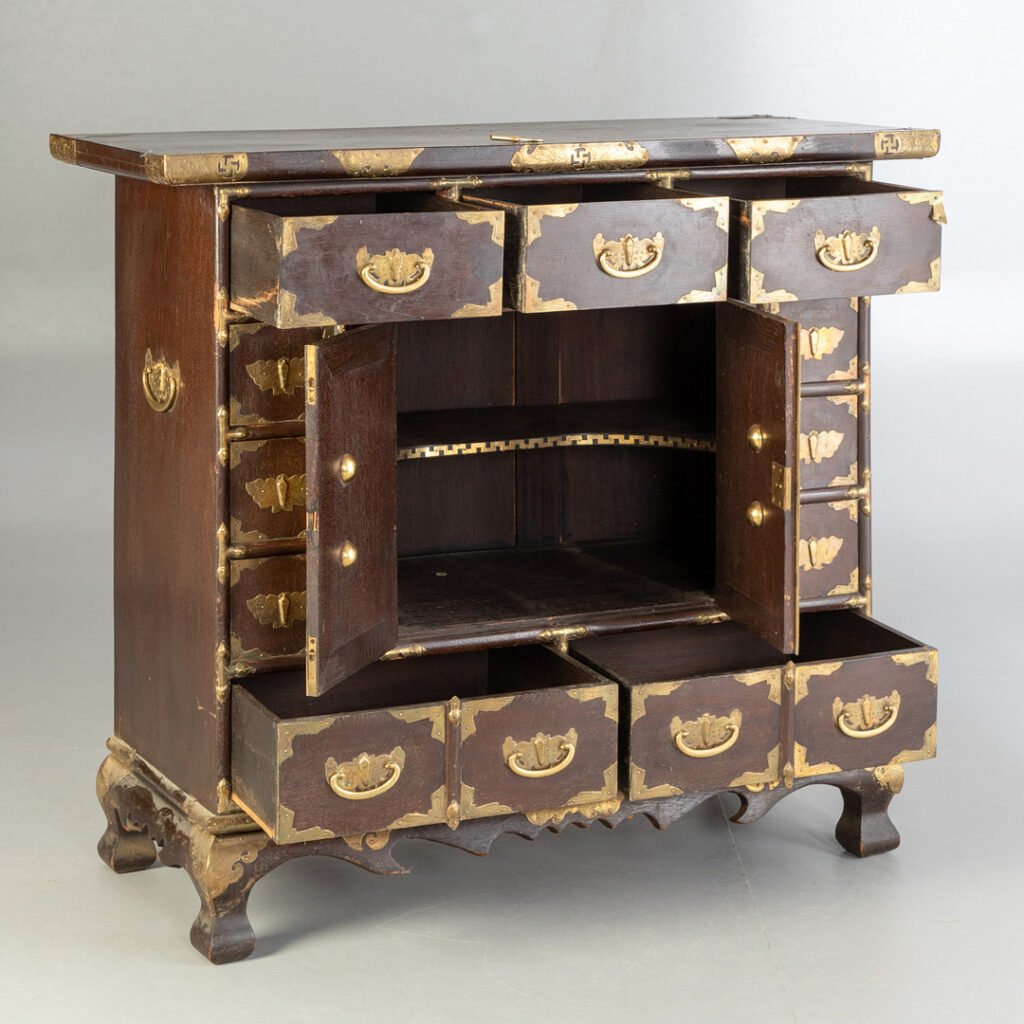
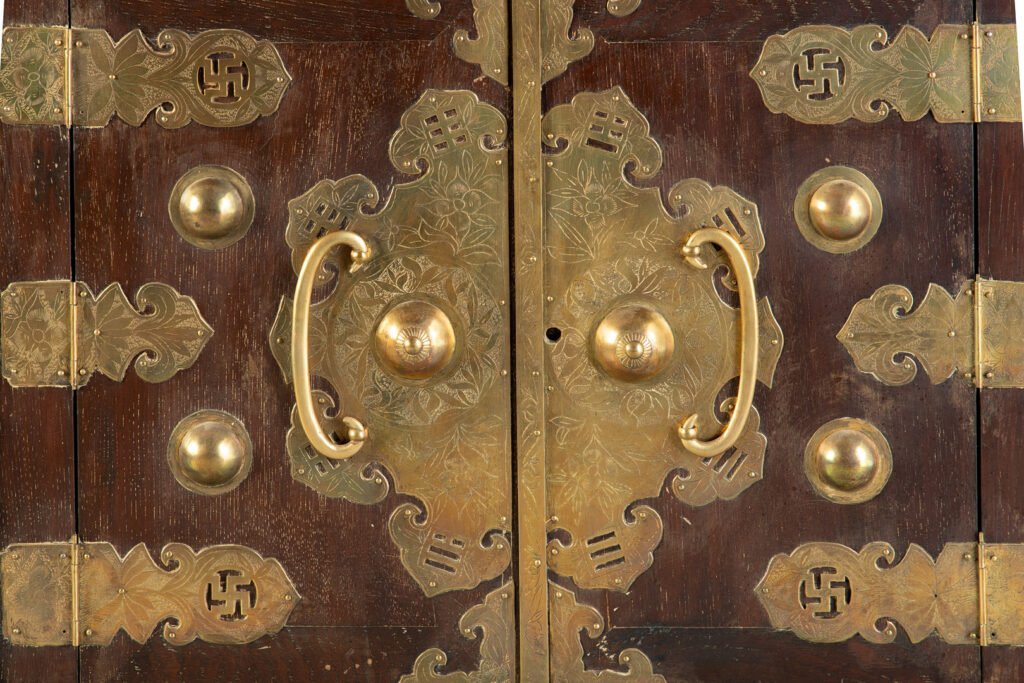
Rectangular body raised on curved feet beneath an arched frame. The front features wing doors enclosing five drawers of varying sizes and blind drawer units. Fitted with ruyi-shaped handles and decorated with brass appliqués in the form of rosettes and bats.
Dimensions: H. 109 cm, W. 122 cm, D. 51 cm.
Provenance: From the private collection of a shipping clerk with Norddeutscher Lloyd, who was employed in East Asian trade in Shanghai and Yokohama until 1940.
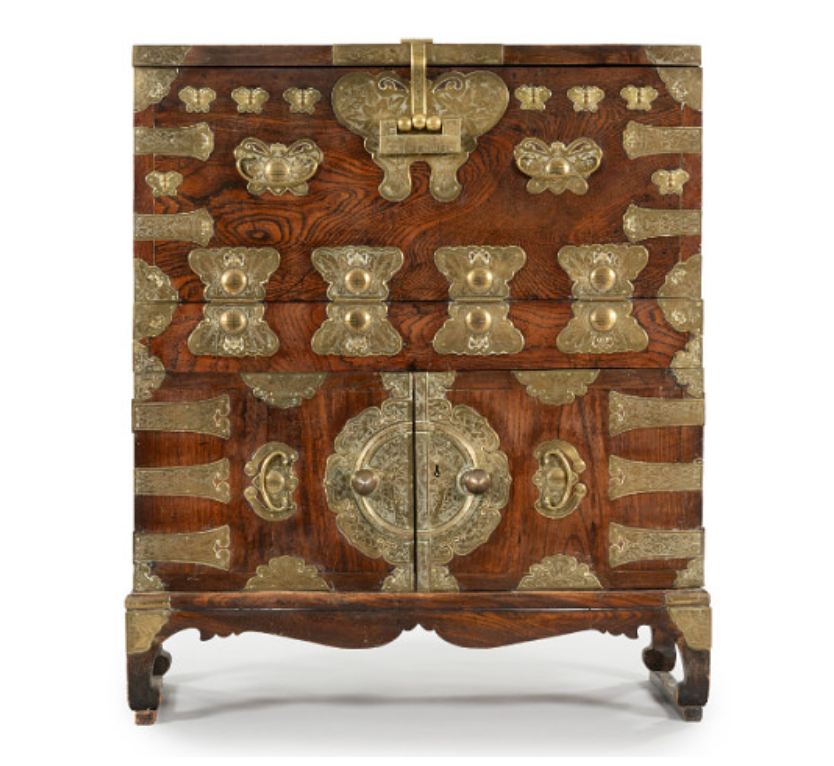
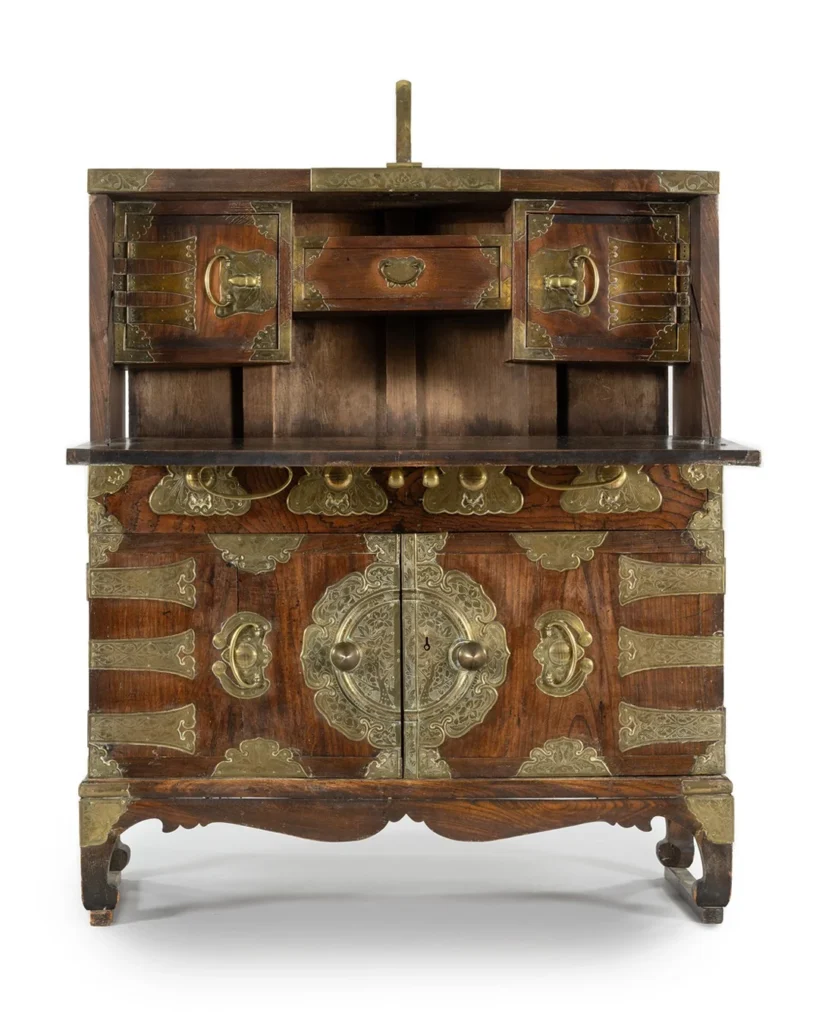
H. 125cm, W. 105cm, D. 44cm.
Elm wood, yellow brass fittings.
This bandaji has been modified for use as a desk.
Early 20th century. Purchased by Eileen Reeve Currier. Donated to the National Folk Museum of Korea.
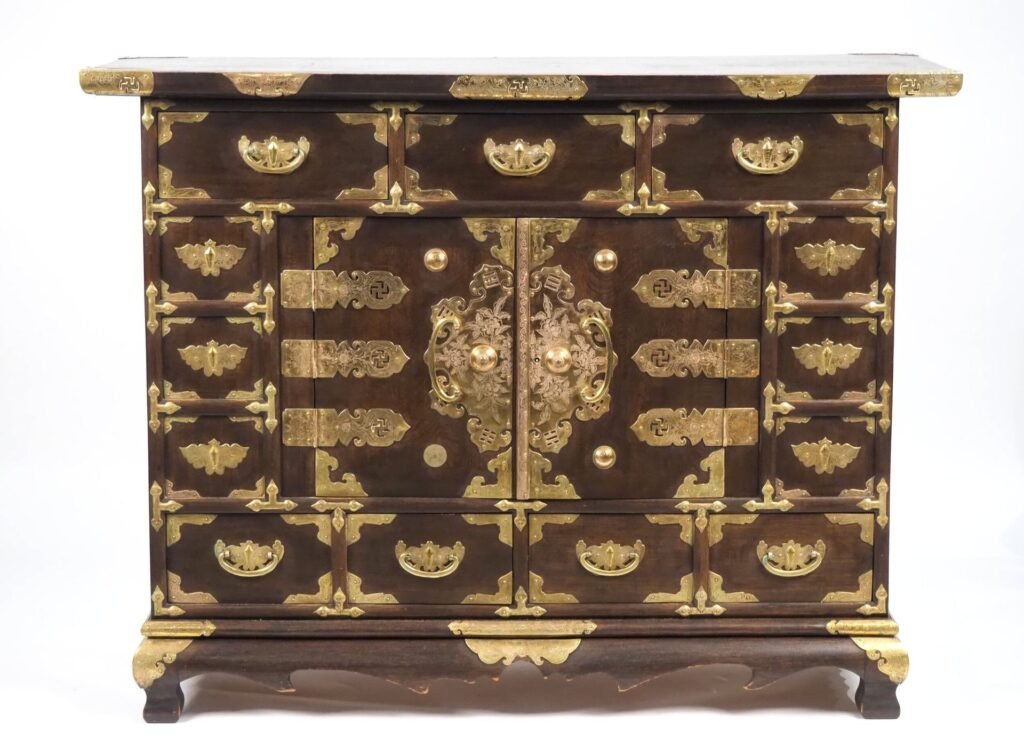
H. 106,5cm, W. 138cm, D. 49,5cm.
Past auction in Paris France.
Japanese colonial rule had a complex and multifaceted impact on Korean furniture, marked by both the disruption of traditional craftsmanship and the introduction of new influences from Japan and the West. This led to a period of transition where indigenous styles were suppressed, repurposed, or hybridized with foreign elements.
Japanese influence: Japanese styles, particularly the use of more prominent decorative metal fittings and lacquerware, were increasingly adopted. Sliding doors and drawer proportions began to follow Japanese tansu logic. This created hybrid pieces, sometimes known as “Richio-tansu” by the Japanese, which were distinct from both pure Korean and Japanese styles.
During their presence on the peninsula, the Japanese did indeed introduce their own furniture styles, and to some extent produced them locally in Korea. The Japanese administration pursued a policy of “cultural assimilation” (naisen ittai, 内鮮一体), the idea that Koreans should live and behave like Japanese citizens. This extended into the home.
As Japanese companies set up factories and furniture workshops in Seoul, Incheon, and Busan, they began producing furniture modeled after Japanese designs, such as chests of drawers, vanities, tea cabinets, and writing desks. These were often built by Korean craftsmen working under Japanese management, sometimes blending local materials with imported construction techniques. Finally, producing furniture locally was cheaper than importing it from Japan.
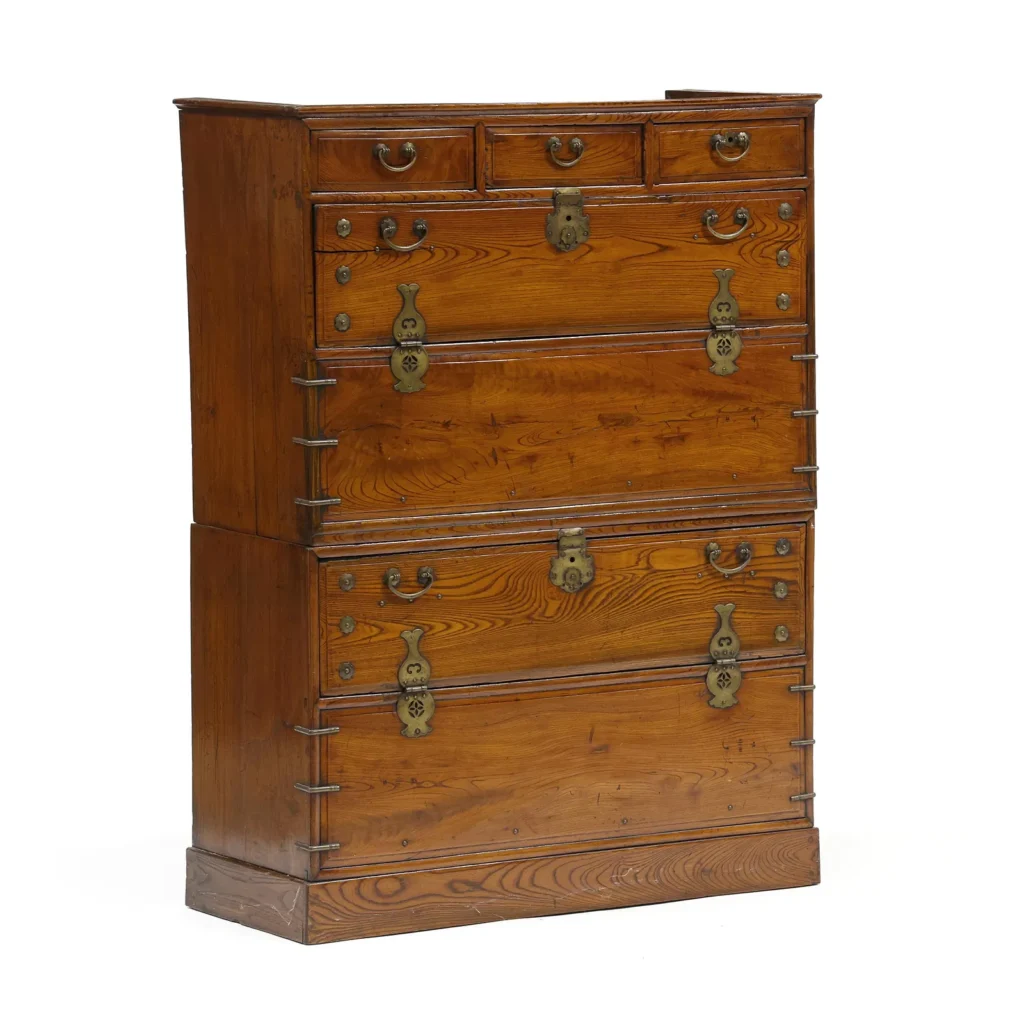
Photo above: While the overall form and construction are unmistakably Japanese ( construction of the top with an elevated frame, base of the chest flat on the floor), this particular chest does show Korean stylistic influence, which likely places it in the colonial-period cross-cultural zone (1910–1940), when Japanese and Korean furniture traditions began to overlap. The decorative brass hinges and lock plates are closer to Korean motifs (especially the “gourd-shaped” and bat-like plates) than to Japanese iron fittings. Therefore we believe that this chest was likely produced in Korea under Japanese colonial influence, or by a workshop influenced by both traditions. Such hybrid pieces were not uncommon between 1910–1940, when Japanese workshops operated in Korea and local craftsmen adapted Japanese furniture models for domestic taste.
The photos below also illustrate the type of furniture introduced during the Japanese colonial period in Korea. The overall design differs significantly from that of the Joseon dynasty. Photos credit: Im_oldstory, Korea.
Traditional Korean late Joseon pieces often have elevated legs or noticeable clearance beneath them.
During the colonial era, many pieces show lower or minimal legs. Traditional Korean hardware often features local motifs (clouds, bats, stylised brass medallions). Colonial-era pieces may use more standardised, less regionally distinctive fittings.
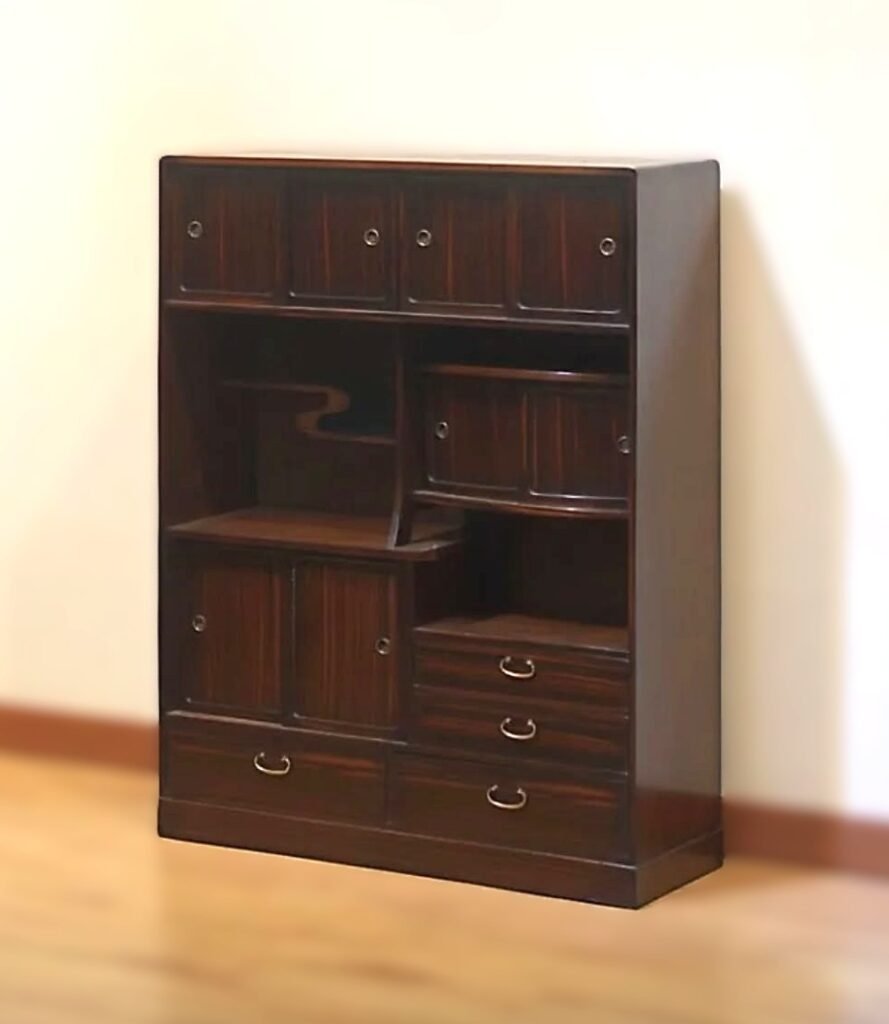
Korea, early to mid-20th century.
Wood, veneer, metal fittings
Rectangular cabinet composed of multiple drawers, sliding doors, and open shelves arranged asymmetrically. The upper and lower sections include pairs of sliding panels with circular metal pulls. The central open compartments feature a curved partition typical of early modern Korean furniture influenced by Japanese tansu designs. Constructed with hardwood veneer over a softwood core and finished in a dark lacquer tone. Such cabinets were produced in urban workshops during the colonial period and used for storing books, tableware, or decorative items in domestic interiors.
H. 105cm, W. 77cm, D. 37cm.
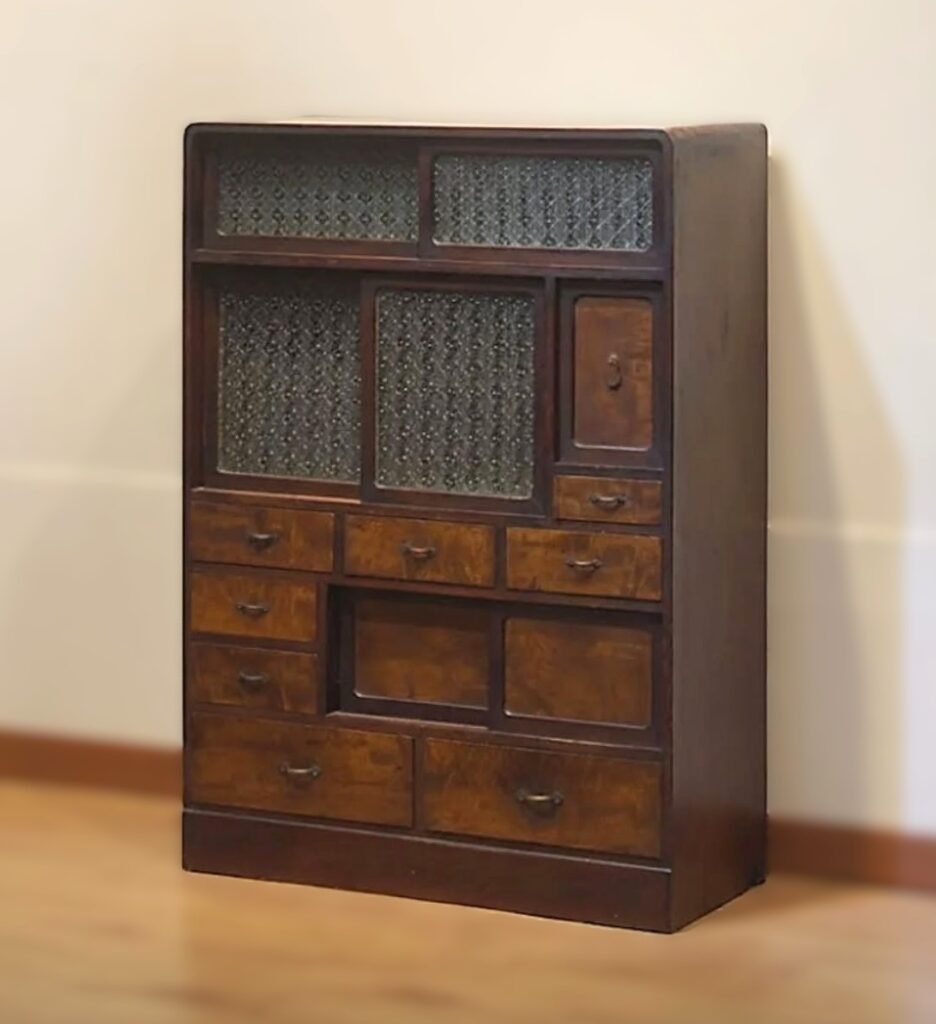
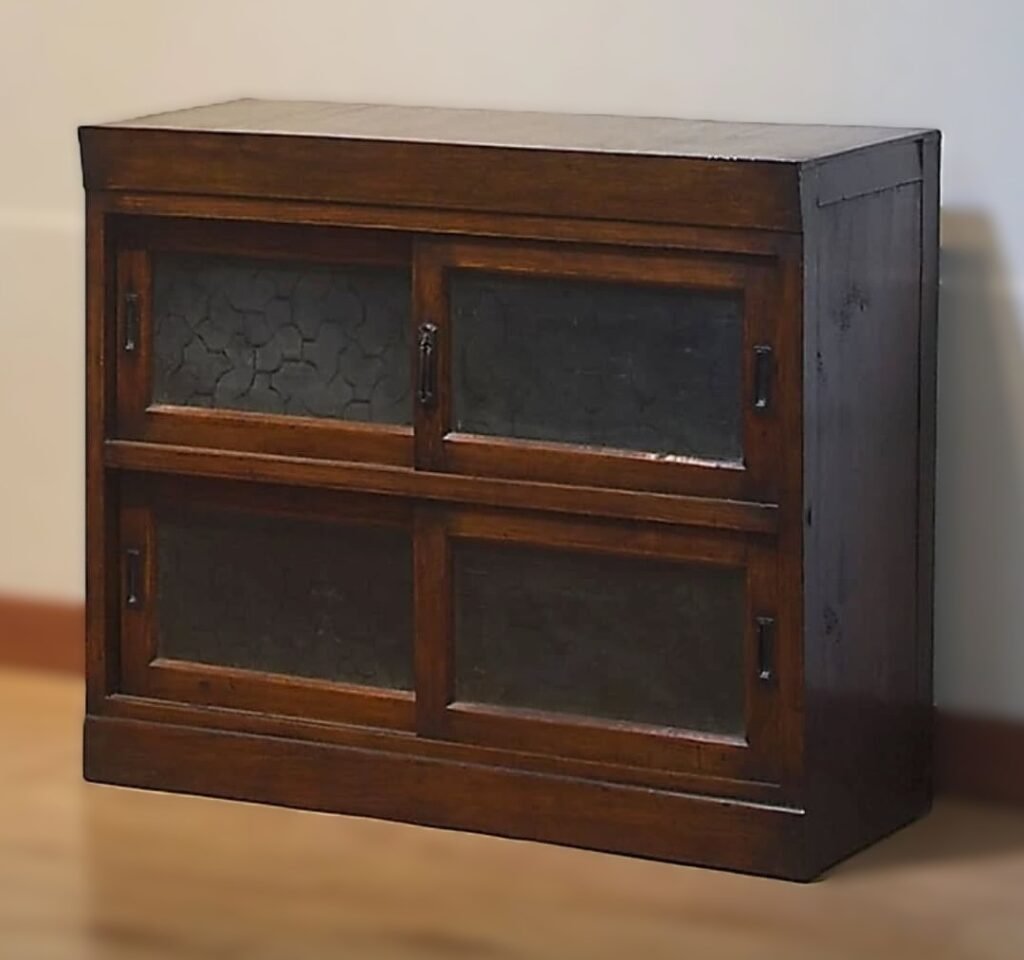
The lower section includes multiple drawers and sliding wooden doors, typical of multi-purpose cabinets used in kitchens or living spaces. The patterned glass, machine-cut drawer pulls point to the 1930s–1940s. H. 114cm, W. 79cm, D. 36cm.
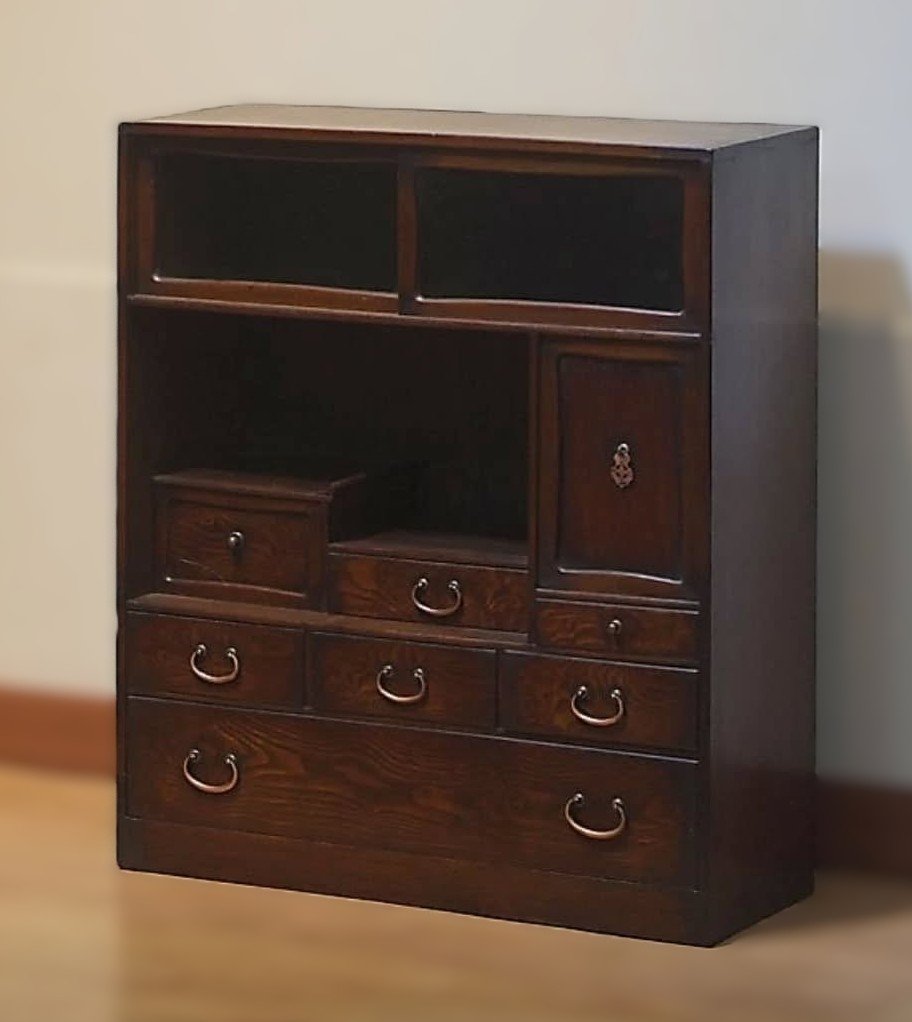
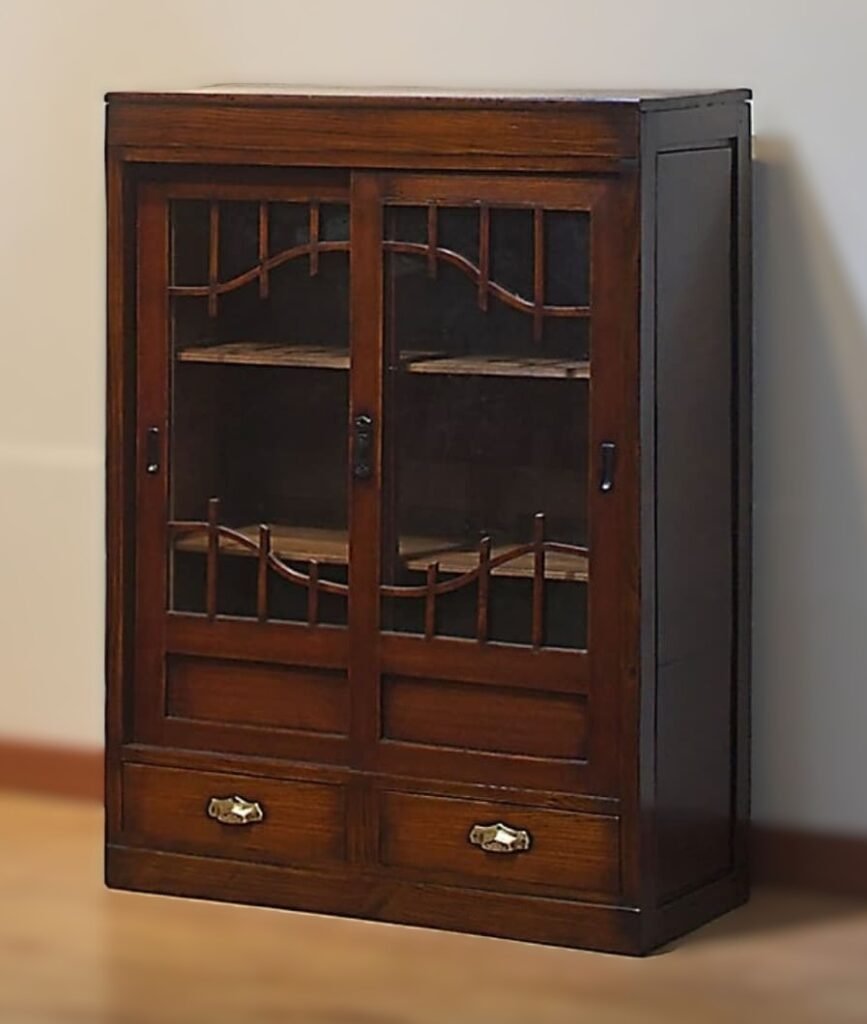
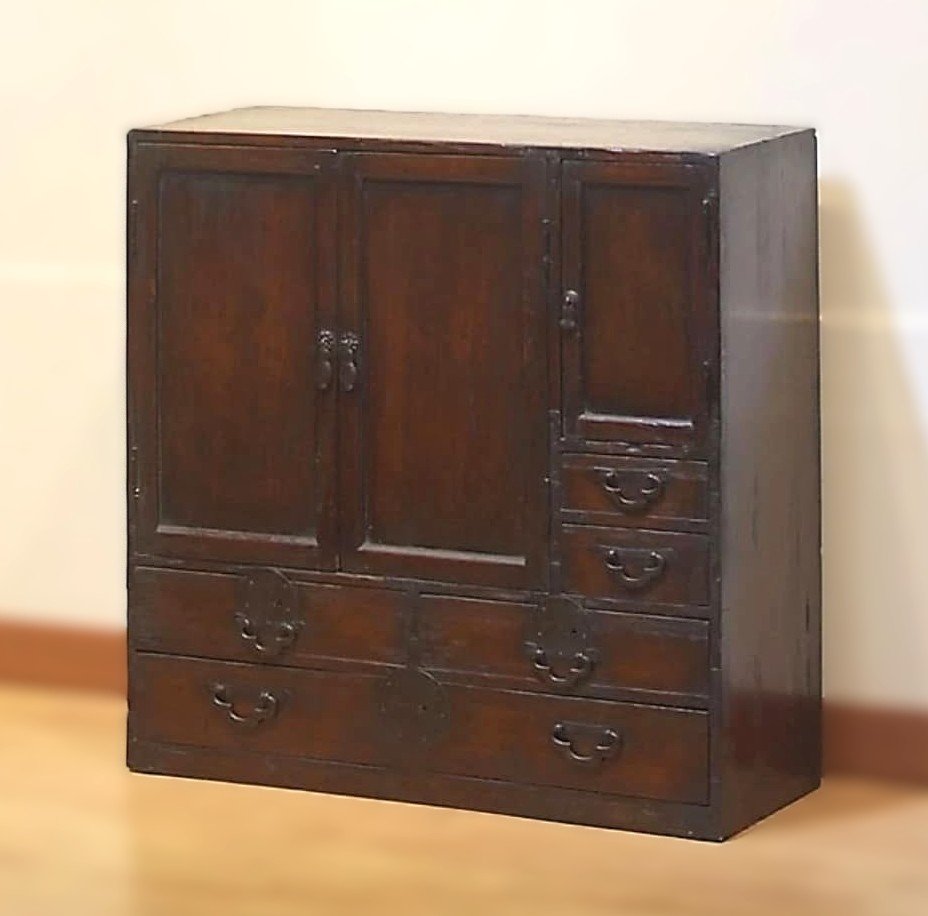
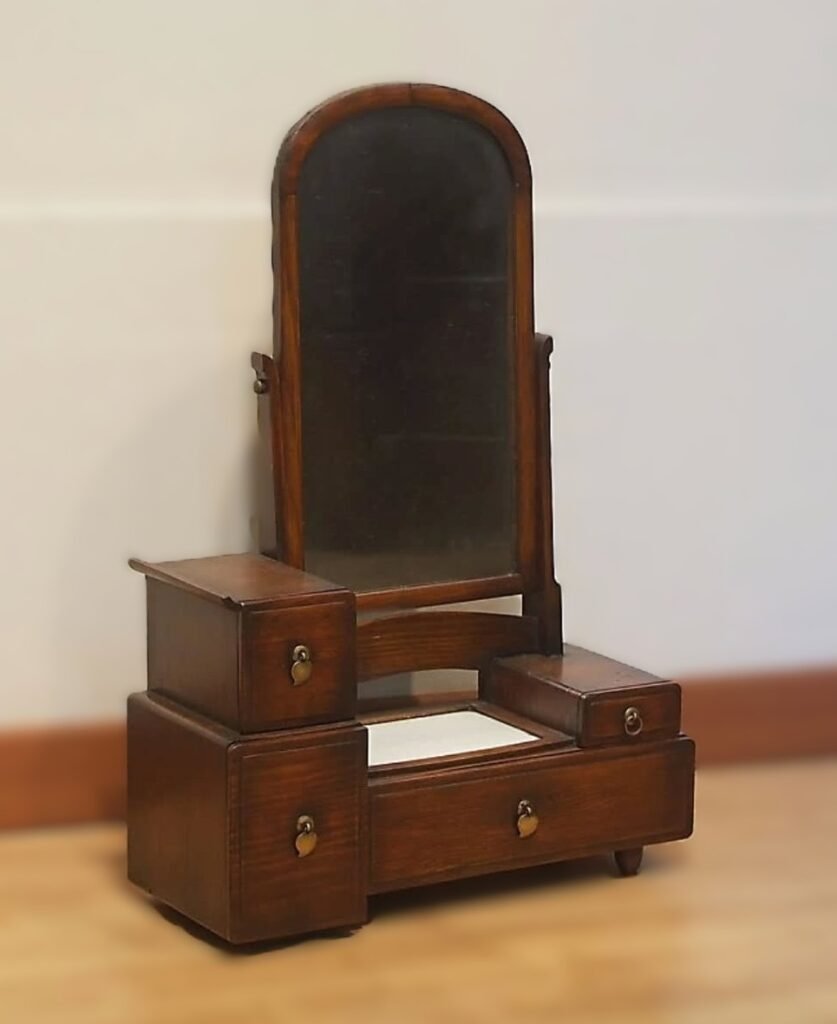
The structure combines a tilting mirror mounted on a low base with multiple drawers and compartments, designed for storing cosmetics, combs, and accessories. The design shows Japanese and Western influence in its symmetry and curved mirror frame, while retaining distinctly Korean construction methods such as dovetail joints and minimal ornamentation.
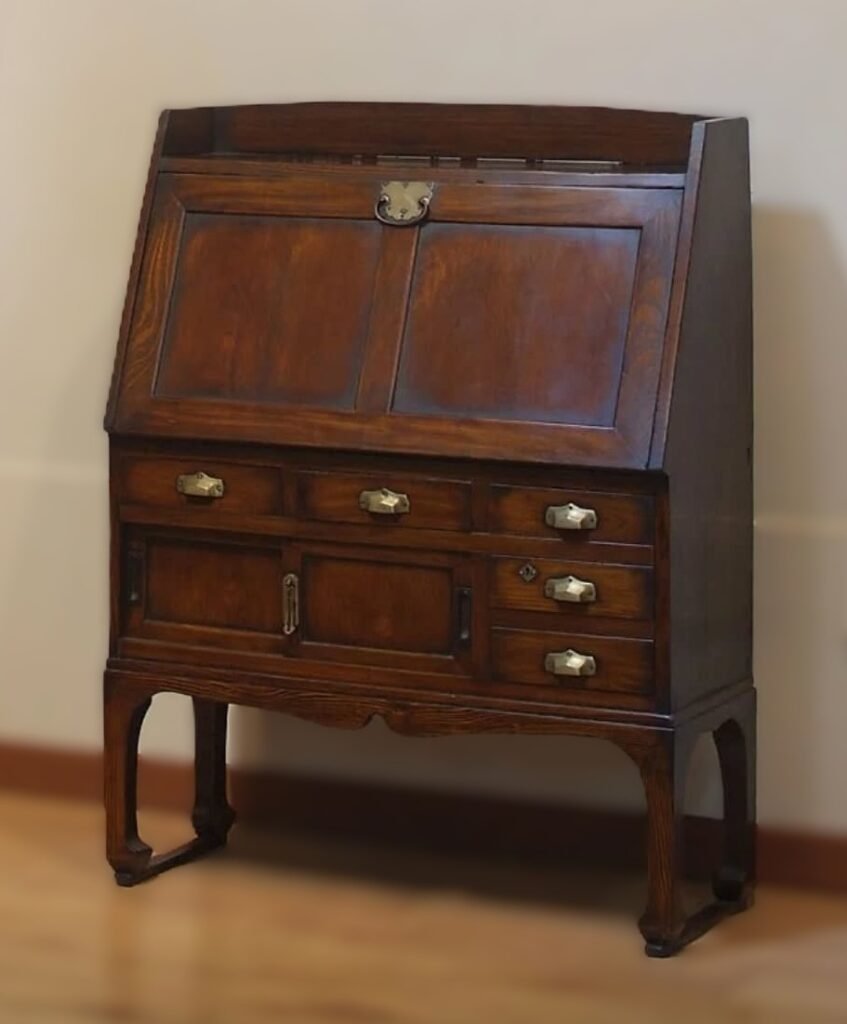
H. 113 cm, W. 87 cm, D. 33 cm.
This hybrid form reflects Japanese stylistic influence during or after the colonial period, when furniture for writing and office use became more common in Korean homes.
IN CONCLUSION.
The late nineteenth and early twentieth centuries marked a turning point in Korean history and traditional craftsmanship. As Korea faced political upheaval, modernization, and growing foreign influence, furniture design also began to change. Some pieces became larger and more richly decorated, reflecting changing tastes, increasing wealth, and a desire to display social status.
Interestingly, similar developments had taken place in nineteenth-century Europe. Although the historical circumstances were different, both societies experienced a shift from simple, functional furniture toward more elaborate designs. Furniture was no longer just a practical household necessity but increasingly became a way to express wealth, taste, and social standing.